Last week I had the privilege of visiting the exhibit Design for the Other 90% : Cities part of a continuing series of exhibits by the Cooper - Hewitt Museum that highlight design solutions for the 90% of the world's population that usually don't receive the benefits from designers working on products and systems to improve their standard of living. This exhibit is at the United Nations, a fitting venue.
The exhibits were models, full size objects, videos, photos and informational boards that focused on public health, clean water, food access, energy and transport. The designs were created for what are termed informal settlements, groups of people forced to resettle because of famine, war, natural disasters or just the search for a better life. These settlements often have poor housing, sanitation and lack of drinking water. While not on the same scale some of the same issues we discuss in reference to the sustainability of community gardens.
One of the exhibits highlighted access to food with a design for a "Garden in a Sack". The sacks are filled with loamy soil and manure, slots are cut on the sides and seedlings planted in the slots. Families can harvest as many as 4 meals per week from their planting. Community groups are adopting the technique in a type of community garden. In some cases they grow enough to sell at market. See my previous posts on Vertical Gardening - growing vegetables in recycled polyester bags from April 15, July 12 and September 26, 2010.
I am also very interested in the use of human power to accomplish tasks that are needed in a garden. Several of the exhibits highlighted using bicycles for transport or producing electricity. One exhibit showed full size examples of a modular bicycle frame that can be used to make a bicycle with a piece of wood or a cart using the same frame. See the included photos.
Another design uses the bicycle to power a charger for a cell phone.
There was a design that used bicycle pedals to pump water from a water tank through a filter system.
For a view of another system, I made a new video showing the improvements I have made to my design for a bicycle water pump.
This exhibit is well worth a visit if you are in NYC. There is also a detailed website worth exploring and a catalogue that can be purchased through the website.
Community Gardening in all of it's manifestations is a proving ground for experiments in social and ecological sustainability. Read How.
Search This Blog
Monday, November 28, 2011
Tuesday, November 15, 2011
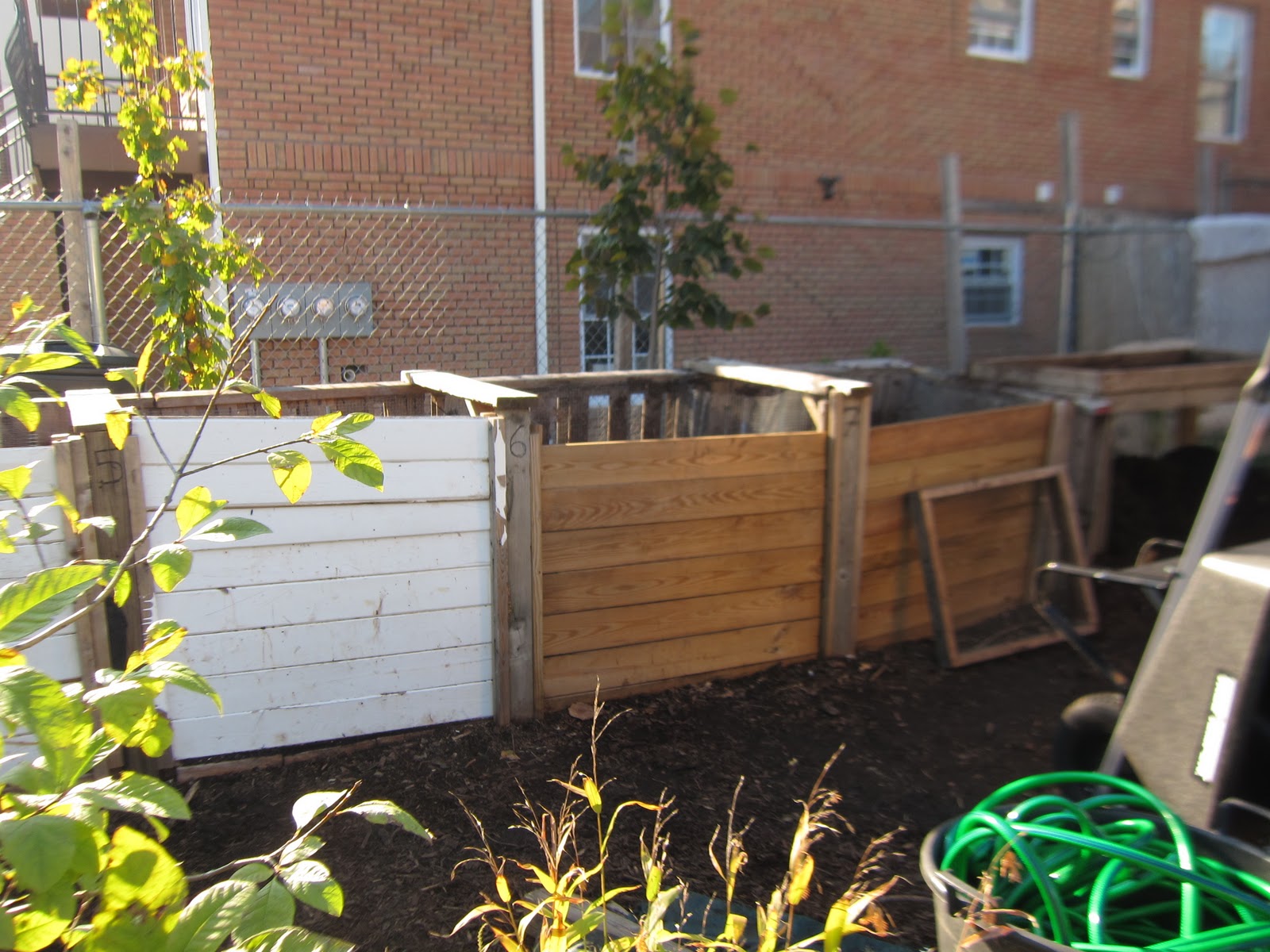
Community Compost Garden
| C4B Bike Trailer |
| Browns and Greens |
![]() |
| Rainwater Harvesting Shed |
| Community Compost Sifter |
| 3 of the compost bins |
| Bins Buckets Shed Sifter Tumblers |
Friday, October 28, 2011
Bicycle Powered Water Pump for Rainwater Harvesting Systems
Making Community Gardens Sustainable is an ongoing theme of this blog and of the work I do during the time when I am not blogging. My most recent project was to devise a human powered water pump using a bicycle. Most community gardens do not have access to electricity to power a pump. A few might have solar panels to run lights or power other devices. Some may have access to electricity from the grid. But the numbers for electrified community gardens is small. Other solutions are necessary for the task of pumping water. I have already worked with an engineering intern to design a treadle pump for pumping water. An earlier blog post describes that effort.
Prototype drill pump on a bike blender
I felt this was a good solution but that creating a pump that worked with a bicycle might be even better for a number of reasons. Most people have a bicycle available to them and there are many used bicycles available for little or no cost. Bicycles and riding a bicycle are also more familiar to most people than a treadle pump. The bicycle could be used as a method of transport when not being used to pump water. Much like the treadle pump, using the bicycle to pump water would also be a form of exercise - a side benefit of this project.
Bike pump using bicycle trainer set up
There are some notable efforts at devising human powered machines. In most cases these efforts are being done in developing nations by international aid organizations or students. A very interesting group is Maya Pedal in Guatemala. They have devised many pedal power machines including corn grinders, nut shellers and wood saws. Youtube has many videos of bicycle powered devices, most often showing ways to generate electricity using a bicycle. That was one direction to work on but I wanted to use the bicycle to drive a pump directly rather than to produce electricity to run the pump.
Close up of the connection between the bike trainer and the drill pump
One idea I had was to use a drill pump. A small inexpensive device that can be attached to a power drill to pump out water in basements, swimming pools and other home uses. I just had to figure out a way to transfer the motion from a bicycle wheel to the drill pump. My first attempt was to use a bicycle blender setup to turn the drill pump instead of a blender. I made a prototype which worked but seemed like too much power was lost doing it this way.
Set up showing connection to the rainwater tank
I then realized that the bicycle trainer that kept the rear wheel off the ground could be adapted to turn the drill pump directly. I made a video that explains how it is done. I have to secure the drill pump and connector pieces better. In the video you will see that the pump is held in place by wires as a temporary solution. I will create a frame of some kind to secure the pump to the bicycle trainer. So it will be one unit easily moved or stored.
This is one small project that along with a number of other small projects can help make community gardens sustainable. With a little funding, hopefully several community gardens that can most use a bicycle water pump for their Rainwater Harvesting systems will get them this coming spring.
Prototype drill pump on a bike blender
I felt this was a good solution but that creating a pump that worked with a bicycle might be even better for a number of reasons. Most people have a bicycle available to them and there are many used bicycles available for little or no cost. Bicycles and riding a bicycle are also more familiar to most people than a treadle pump. The bicycle could be used as a method of transport when not being used to pump water. Much like the treadle pump, using the bicycle to pump water would also be a form of exercise - a side benefit of this project.
Bike pump using bicycle trainer set up
There are some notable efforts at devising human powered machines. In most cases these efforts are being done in developing nations by international aid organizations or students. A very interesting group is Maya Pedal in Guatemala. They have devised many pedal power machines including corn grinders, nut shellers and wood saws. Youtube has many videos of bicycle powered devices, most often showing ways to generate electricity using a bicycle. That was one direction to work on but I wanted to use the bicycle to drive a pump directly rather than to produce electricity to run the pump.
Close up of the connection between the bike trainer and the drill pump
One idea I had was to use a drill pump. A small inexpensive device that can be attached to a power drill to pump out water in basements, swimming pools and other home uses. I just had to figure out a way to transfer the motion from a bicycle wheel to the drill pump. My first attempt was to use a bicycle blender setup to turn the drill pump instead of a blender. I made a prototype which worked but seemed like too much power was lost doing it this way.
Set up showing connection to the rainwater tank
I then realized that the bicycle trainer that kept the rear wheel off the ground could be adapted to turn the drill pump directly. I made a video that explains how it is done. I have to secure the drill pump and connector pieces better. In the video you will see that the pump is held in place by wires as a temporary solution. I will create a frame of some kind to secure the pump to the bicycle trainer. So it will be one unit easily moved or stored.
This is one small project that along with a number of other small projects can help make community gardens sustainable. With a little funding, hopefully several community gardens that can most use a bicycle water pump for their Rainwater Harvesting systems will get them this coming spring.
Wednesday, October 19, 2011
Update on Community Garden and Urban Agriculture Plans and Policies
Cities across the US are beginning to be enlightened to creating ordinances, policies and zoning to allow
and even encourage urban agriculture and community gardening. A recent New York Times article
highlighted the fact that some cites particularly in the Midwest and Northeast have large numbers of
vacant lots with little demand from developers to build on them.
In some cases the policies are urban agriculture policies which are aimed toward allowing food
growing in urban areas as an entrepreneurial enterprise. In fact there was a flurry of activity this
spring as San Francisco passed what they are calling the "most progressive" urban agriculture
ordinance in the US. on April 14, 2011.
This policy was the result of advocacy work done by small urban farmers who wanted a positive
policy.
One day later Minneapolis adopted the first Urban Agriculture Policy Plan for that city. The
Minneapolis plan was crafted by a group of around 100 stakeholders.
Other cities are working on policies and pans including Oakland, CA, Chicago and Detroit. All
three cities have plans that are currently being debated.
As I wrote in previous posts, New York City passed a new rule about community gardens and
also passed Foodworks - comprehensive food policy that includes provisions for rooftop farms
as well as other healthy food initiatives.
Seattle has always been in the forefront having included community gardens in their city plans for
many years. The plan establishes a goal of one community garden for every 2,500 households in
the city.
and even encourage urban agriculture and community gardening. A recent New York Times article
highlighted the fact that some cites particularly in the Midwest and Northeast have large numbers of
vacant lots with little demand from developers to build on them.
This has been a problem for many years in Philadelphia and Cleveland.In fact,Cleveland has a very
strong Urban Agriculture policy. In fact it will be the topic of discussion at an upcoming October
Experts Panel Conference Call for ACGA Members with Morgan Taggart giving the Cleveland story
and Bill Maynard information about Sacramento's community garden friendly policy.
strong Urban Agriculture policy. In fact it will be the topic of discussion at an upcoming October
Experts Panel Conference Call for ACGA Members with Morgan Taggart giving the Cleveland story
and Bill Maynard information about Sacramento's community garden friendly policy.
In some cases the policies are urban agriculture policies which are aimed toward allowing food
growing in urban areas as an entrepreneurial enterprise. In fact there was a flurry of activity this
spring as San Francisco passed what they are calling the "most progressive" urban agriculture
ordinance in the US. on April 14, 2011.
This policy was the result of advocacy work done by small urban farmers who wanted a positive
policy.
One day later Minneapolis adopted the first Urban Agriculture Policy Plan for that city. The
Minneapolis plan was crafted by a group of around 100 stakeholders.
Other cities are working on policies and pans including Oakland, CA, Chicago and Detroit. All
three cities have plans that are currently being debated.
As I wrote in previous posts, New York City passed a new rule about community gardens and
also passed Foodworks - comprehensive food policy that includes provisions for rooftop farms
as well as other healthy food initiatives.
Seattle has always been in the forefront having included community gardens in their city plans for
many years. The plan establishes a goal of one community garden for every 2,500 households in
the city.
All of this policy activity bodes well for the legitimacy and longevity of community gardens and
urban agriculture initiatives. The next steps should be the creation of new community gardens
and urban farms, sharing of best practices among practitioners and support from all levels of
government, higher education and foundation that recognizes the importance of community
gardens to the environment and health of our cities.
urban agriculture initiatives. The next steps should be the creation of new community gardens
and urban farms, sharing of best practices among practitioners and support from all levels of
government, higher education and foundation that recognizes the importance of community
gardens to the environment and health of our cities.
Monday, October 10, 2011
Community Gardens and Occupy Wall Street
The Occupy Wall Street movement has spread to many cities in the US and many folks I know have been discussing what is going on. The comments have ranged from some expressing an interest in joining the movement and others having opinions both supportive and opposed on the issues being raised. Others have asked me whether I will join those in Liberty Park - the name the occupiers have given to Zuccotti Park where many have spent their days and nights. I have not been there to spend a lot of time but did stop by to see what was happening and took a couple of photos. While I may not be able to spend a night there I can talk about it in my blog. It is set up like a small town with the areas designated by the needs of a gathering like this: a meeting area, a sleeping area, a cooking area, a library, a media center and a work area (mostly for making signs).
The occupiers spend a lot of time meeting and discussing what they will do, what messages they will broadcast to the world and how they will organize themselves and make decisions. The use of press media and social media is widespread from a website to Facebook and Twitter, There is even a 4 page printed paper called The Occupied Wall Street Journal which of course is also available as a .pdf The Occupied Wall Street Journal .
So what does Occupy Wall Street have to do with community gardening? Many of my posts have stressed the importance of social sustainability and how community gardening groups are testing grounds for how to organize a group to make decisions and to get the work of community gardening accomplished. The occupiers at Liberty Park say they are using modified consensus to make decisions. This is a very practical way to make decisions as everyone has a say but just 1 person can't hold up making a decision. Both this movement and community gardening are showing us how to organize and make decisions where everyone's voice can be heard.
Occupy Wall Street is also space based. The group is occupying a public space to use for what they see ( and I agree) is an important purpose. Community Gardeners also occupy underutilized city spaces to create neighborhood amenities, grow food and improve their communities. If I might suggest what the overriding message from the occupiers could be is just that the dollars that are in the hands of the 1% be used so that this energy can be focused to create neighborhood amenities, grow food and improve their communities.
The community gardeners often ask for more space for more gardens. The Occupy Wall Street folks are saying that they are running out of space in Liberty Park and are looking to expand to other parks in the city. That will be an interesting next step. I am curious how that will play out.
One excellent clue about what can be done may be happening in one of my favorite gardens, Drew Gardens in the Bronx which recently began a project with the International Rescue Committee to give refugees a chance to grow foods from their homelands, to interact with others in their position and improve their lives. An article today about ethnic farmers markets also included a reference to Drew Gardens .
What it comes down to is that everyone wants a productive life. How that will happen and what it will look like is still to be determined. Looking at community gardens may give us a few clues.
So what does Occupy Wall Street have to do with community gardening? Many of my posts have stressed the importance of social sustainability and how community gardening groups are testing grounds for how to organize a group to make decisions and to get the work of community gardening accomplished. The occupiers at Liberty Park say they are using modified consensus to make decisions. This is a very practical way to make decisions as everyone has a say but just 1 person can't hold up making a decision. Both this movement and community gardening are showing us how to organize and make decisions where everyone's voice can be heard.
Occupy Wall Street is also space based. The group is occupying a public space to use for what they see ( and I agree) is an important purpose. Community Gardeners also occupy underutilized city spaces to create neighborhood amenities, grow food and improve their communities. If I might suggest what the overriding message from the occupiers could be is just that the dollars that are in the hands of the 1% be used so that this energy can be focused to create neighborhood amenities, grow food and improve their communities.
The community gardeners often ask for more space for more gardens. The Occupy Wall Street folks are saying that they are running out of space in Liberty Park and are looking to expand to other parks in the city. That will be an interesting next step. I am curious how that will play out.
One excellent clue about what can be done may be happening in one of my favorite gardens, Drew Gardens in the Bronx which recently began a project with the International Rescue Committee to give refugees a chance to grow foods from their homelands, to interact with others in their position and improve their lives. An article today about ethnic farmers markets also included a reference to Drew Gardens .
What it comes down to is that everyone wants a productive life. How that will happen and what it will look like is still to be determined. Looking at community gardens may give us a few clues.
Friday, October 7, 2011
Harvest Time
Here in the Northeast harvest season is winding down. There are late season crops that are still to be harvested but the bulk of harvesting has taken place already and many cities and communities have harvest festivals. These festivals are fun events that include contests, games, music, art and of course food.
For community gardeners it is a time to show off their best flowers, largest and most perfect veggies and fruit and bountiful baskets from their gardens. The competitions can be intense but they are also a time to compare growing techniques, new varieties and best practices. The harvest fairs are a great time to learn from others and to make resolutions for next year.
Harvest Fairs and Festivals happen in many places like Juneau, Alaska , Brownwood, Texas , Toronto, Canada , Bronx, New York , San Francisco and St. Louis, Missouri to link to just a few. Each has a different flavor or theme. A harvest festival tour would be a fun vacation.
I have been a judge in a number of harvest fairs though I missed this year. It is wonderful to see the variety of peppers, tomatoes, cucumbers and squashes that people grow. Often it is difficult to choose between first and second place. In some cases I want to give everyone a ribbon. There are usually very strict contest rules - the number and size of fruits, the length of the stems, absence of blemishes - that will sometimes rule out otherwise good entries. Most important is that folks have an opportunity to be recognized for the work they put in during the season.
For community gardeners it is often the only time when they get recognition for the many hours that they volunteered to improve their neighborhoods. Most often community gardeners are challenged about what they are not doing. How come your plot is so weedy? Why is all of this trash in the garden? Why wasn't the garden open yesterday? Why didn't you come to the meeting? Somebody forgot to lock the shed!!
It may happen that someone passes by and says thanks for what you are doing but complaints are far more frequent. So beyond all of the fun and games the nicest thing about harvest fairs are those ribbons and the well deserved acknowledgement that the community gardeners receive. Congratulations for and thanks to community gardeners for all you have done this year and Happy Harvest Time!
For community gardeners it is a time to show off their best flowers, largest and most perfect veggies and fruit and bountiful baskets from their gardens. The competitions can be intense but they are also a time to compare growing techniques, new varieties and best practices. The harvest fairs are a great time to learn from others and to make resolutions for next year.
Harvest Fairs and Festivals happen in many places like Juneau, Alaska , Brownwood, Texas , Toronto, Canada , Bronx, New York , San Francisco and St. Louis, Missouri to link to just a few. Each has a different flavor or theme. A harvest festival tour would be a fun vacation.
I have been a judge in a number of harvest fairs though I missed this year. It is wonderful to see the variety of peppers, tomatoes, cucumbers and squashes that people grow. Often it is difficult to choose between first and second place. In some cases I want to give everyone a ribbon. There are usually very strict contest rules - the number and size of fruits, the length of the stems, absence of blemishes - that will sometimes rule out otherwise good entries. Most important is that folks have an opportunity to be recognized for the work they put in during the season.
For community gardeners it is often the only time when they get recognition for the many hours that they volunteered to improve their neighborhoods. Most often community gardeners are challenged about what they are not doing. How come your plot is so weedy? Why is all of this trash in the garden? Why wasn't the garden open yesterday? Why didn't you come to the meeting? Somebody forgot to lock the shed!!
It may happen that someone passes by and says thanks for what you are doing but complaints are far more frequent. So beyond all of the fun and games the nicest thing about harvest fairs are those ribbons and the well deserved acknowledgement that the community gardeners receive. Congratulations for and thanks to community gardeners for all you have done this year and Happy Harvest Time!
Sunday, September 11, 2011
Post Community Gardening Conference Thoughts
Attending the community gardening conference last month in New York City, gave me the opportunity to share ideas and make connections with other community gardeners. It also provoked some thoughts and ideas. From the large proportion of sessions devoted to research it became clear that the glaring omission was the lack of a national survey and census of community gardens. In fact I spent a little time at the conference talking to folks about what that might look like and how it might be done. I plan to spend some time in the coming months working on that project. such a survey could pinpoint where there are opportunities for more community gardens.
On a Tour at the Conference
The overwhelming interest in community gardening from around this country and the world makes one think about the big picture. Shouldn't cities plan in advance for community garden or urban agriculture spaces? Particularly cities that have vacant land because population has declined but also cities that are growing that have the opportunity to set aside space for community gardens before that space is is built upon. Both types of cities can develop policies to encourage and promote community gardens.
A narrow lane in a village in Sicily
A recent New York Times article focused on Cleveland as an example of a city with available land and shrinking population. While the article focuses on a study of the benefits of a vacant lot in terms of habitat and biodiversity, my interest piqued when the article mentioned the opportunity for cities to do something positive with the land. While at this time cities like Cleveland and other Northeast (Philadelphia) and Midwest (Youngstown, OH) cities are losing population to the Southeast and Southwest, there may come a time when the Southern cities will have reached their limits to growth particularly because of lack of drinking water. With the ongoing drought conditions in these regions that time may be very soon. And that will be a time when the Northern cities could increase their populations in a well planned manner that includes adequate open space and room for community gardens and urban agriculture.
Melons being sold off the back of a truck in Sicily
I can see redevelopment of neighborhoods in a sustainable way that takes into account transportation, commerce, agriculture and recreation in addition to housing. These neighborhoods could and should have as small a carbon footprint as possible. I just returned from a vacation in Sicily and I was struck by 3 things. One was the incredible beauty of the land. Second was how tasteful the food was. Not just the cooked food but even the raw ingredients. Peaches and Melons were in season and the flavor of the fruit was much stronger and fresher than the same fruit in season here. Was it that it was local? Third was that all of the towns were densely built with narrow roads and attached buildings everywhere. Of course the Sicilians love their (mostly very small) cars so there was traffic even in these small towns. But there was also alternative transportation. As much of the land was hilly, I rode in cable cars called Funuvia on 2 occasions. Olive trees and Grapes grew everywhere and particularly just outside of the towns were small farms. Could these small towns be models for what these new neighborhoods could be?
On a Tour at the Conference
The overwhelming interest in community gardening from around this country and the world makes one think about the big picture. Shouldn't cities plan in advance for community garden or urban agriculture spaces? Particularly cities that have vacant land because population has declined but also cities that are growing that have the opportunity to set aside space for community gardens before that space is is built upon. Both types of cities can develop policies to encourage and promote community gardens.
A narrow lane in a village in Sicily
A recent New York Times article focused on Cleveland as an example of a city with available land and shrinking population. While the article focuses on a study of the benefits of a vacant lot in terms of habitat and biodiversity, my interest piqued when the article mentioned the opportunity for cities to do something positive with the land. While at this time cities like Cleveland and other Northeast (Philadelphia) and Midwest (Youngstown, OH) cities are losing population to the Southeast and Southwest, there may come a time when the Southern cities will have reached their limits to growth particularly because of lack of drinking water. With the ongoing drought conditions in these regions that time may be very soon. And that will be a time when the Northern cities could increase their populations in a well planned manner that includes adequate open space and room for community gardens and urban agriculture.
Melons being sold off the back of a truck in Sicily
I can see redevelopment of neighborhoods in a sustainable way that takes into account transportation, commerce, agriculture and recreation in addition to housing. These neighborhoods could and should have as small a carbon footprint as possible. I just returned from a vacation in Sicily and I was struck by 3 things. One was the incredible beauty of the land. Second was how tasteful the food was. Not just the cooked food but even the raw ingredients. Peaches and Melons were in season and the flavor of the fruit was much stronger and fresher than the same fruit in season here. Was it that it was local? Third was that all of the towns were densely built with narrow roads and attached buildings everywhere. Of course the Sicilians love their (mostly very small) cars so there was traffic even in these small towns. But there was also alternative transportation. As much of the land was hilly, I rode in cable cars called Funuvia on 2 occasions. Olive trees and Grapes grew everywhere and particularly just outside of the towns were small farms. Could these small towns be models for what these new neighborhoods could be?
Subscribe to:
Posts (Atom)