In what was another example of the maxim that one size does not fit all in terms of community garden policies, the Staten Island Grow to Give Conference for Community Gardens and Food Pantries highlighted how different the reality of community gardening is on Staten Island compared to the rest of New York City. This conference was held at the St. John's University Staten Island Campus with 64 people braving a minor snow storm to attend.
I was part of the planning committee and one of the lead organizers of the conference. The conference grew out of the Staten Island Hunger Task Force, where the task force group wanted to start more community gardens on Staten Island to grow more fresh fruit and vegetables for the island's food pantries. The task force members decided that a conference that brought together community gardeners, food pantry organizers and volunteer groups could be the catalyst to create more gardens on Staten Island and to link both the existing gardens and new ones to food pantries. There was also the need to address logistics for even the most basic need as getting the produce from the gardens to the pantries.
Originally we thought there were only 2 community gardens on Staten Island but through outreach for the conference that number reached 8. and around 30 food pantries. Staten Island has the smallest population of New York City's 5 boroughs with just over 500,000 residents. One very active garden the Staten Island Moravian garden actually was a perfect example of what the conference organizers wanted to see, a garden that donates produce to a local food pantry, Project Hospitality. Another community garden, the Roots of Peace Community garden, that started just last summer was on private land but received technical support from the Staten Island office of the New York City Department of Parks and Recreation. A little research by the director of the New York City municipal community gardening program, GreenThumb, revealed that there was only 1 vacant lot under the jurisdiction of the Housing Preservation and Development city agency (HPD) which was the source of most of the vacant lots that developed into community gardens in the other 4 boroughs of New York City. In comparison Brooklyn has 900 HPD lots. So any future gardens would have to be created on other vacant or underutilized land.
As the Castleton Hill Moravian Church showed, one possibility is church land. There are over 100 churches on Staten Island, many with underutilized land and some with food pantries. Despite the lack of city owned vacant land, there are many privately owned vacant lots as in the case of the Roots of Peace community garden and 2 others that were identified as community gardens on private property. Some of the new community gardens could be built on church or private land. Staten Island also boasts over 12,300 acres of protected parkland including federal, state and city parks. In fact one of Staten Island's community gardens is in Miller Field in Gateway National Recreation Area. Some of these acres parkland are underutilized land that could be turned into community gardens.
Volunteer and other groups that could provide manpower were represented by groups like the Girl Scouts, Morgan Stanley and youth probation department.
This conference gave Staten Islanders a better picture of what community gardens exist today and how to get involved, how to start new gardens, where to look for land to start new gardens, how to connect to food pantries and what groups might provide helping hands. It also showed those of us who are concerned about community garden policies that even in a particular city, one policy does not fit all possible scenarios.
Community Gardening in all of it's manifestations is a proving ground for experiments in social and ecological sustainability. Read How.
Search This Blog
Sunday, January 22, 2012
Thursday, December 29, 2011
Community Gardening : the Year in Review
This is the time of year that it seems like everyone has a list of top tens of everything and there are plenty of year in review stories. Here is my index of the year of the Community Gardening Blog. As I think back on 2011, I realize that a lot happened in the community gardening world, even more than I realized. Maybe that is why I haven't blogged as frequently as I would have liked; I was busy doing things. There were a number of events starting with the New Jersey Community Gardening Symposium at the Frelinghuysen Arboretum but also including the annual spring events, Making Brooklyn Bloom and the GreenThumb GrowTogether as well as the ACGA conference held in New York City this past summer.
There was a lot of discussion and a lot written about plans and policies for community gardens and urban agriculture. In New York City we had a new "Rule" which passes for policy in this complicated city but of course isn't. So far there have not been any tests to see whether the Rule is strong protection for the gardens or not or what changes can be added to make it stronger. If this was a blog predicting what will happen in 2012, I would say that we will hear a lot more about this Rule. I can guarantee that you will hear and read more from me about policies in 2012.
With all of the talk of spending cuts coming from Washington and Albany there was on again and off again threat, worry and angst about whether the GreenThumb program will be cut a little, a lot or drastically. Nothing has happened yet although at this time it seems the cuts may just be a little. One of our wishes for 2012 is for more funds instead of cuts for GreenThumb. If only we has better news to report about the New York State Community Gardening Program. The coordinator left at the end of the summer for a new (not state) position and no one there answers the phone or replies to voice messages. The future for that program does not look so rosy.
We may have to include the New York State Community Gardening Program among those we have lost this year. We also marked the 25th anniversary of the loss of Adam Purple's Garden of Eden which was the first community garden loss that made headlines. Another of the wishes for 2012 is that there won't be any community garden losses in 2012 but rather a lot of new gardens about which I can report. An updated survey of community gardens will be released this year which should show increased numbers of community gardens in most cities from 1998 when the last survey was released. I know there will be a local conference 'Grow to Give' in Staten Island on January 21st to encourage more community gardens on Staten Island and to make the connections between volunteers, land and resources with the hope of growing more produce for Staten Island food pantries.
A number of 2011 posts were devoted to my early years in community gardening traced through the creation of the 6BC Community Garden. That is something that I have been wanting to write about for many years and I am happy that I had the opportunity to share with you. I hope there will be more to add to the story in 2012, both stories from the past and new stories to come.
It was great to visit Compost for Brooklyn and add Community Compost Garden to the list of possibilities for community gardening. The Occupy Wall Street Movement inspired moving the Bicycle Water Pump from a germ of an idea to a working model. There will be pictures of these pumpers to show in a number of community gardens this season. Compost for Brooklyn needs a human powered leaf shredder. I wonder how that will work?? In addition to the Bicycle Water Pump, Occupy Wall Street also helped to show the world about the importance of process and developing a political and social structure that is inclusive. It reaffirms what I have written about the sustainability of community gardens being as dependent on the social sustainability of the garden group as it is on the physical space.
Not quite your traditional index, year in review, new year predictions or memorials but all rolled into one with the good news and bad and the hopes and dreams for next year which is only 2 days away. There are many reasons to believe that 2012 will be full of accomplishments and forward movement in community gardening and the work we have done this year will be a strong foundation on which to build. Blog with you next year!
There was a lot of discussion and a lot written about plans and policies for community gardens and urban agriculture. In New York City we had a new "Rule" which passes for policy in this complicated city but of course isn't. So far there have not been any tests to see whether the Rule is strong protection for the gardens or not or what changes can be added to make it stronger. If this was a blog predicting what will happen in 2012, I would say that we will hear a lot more about this Rule. I can guarantee that you will hear and read more from me about policies in 2012.
With all of the talk of spending cuts coming from Washington and Albany there was on again and off again threat, worry and angst about whether the GreenThumb program will be cut a little, a lot or drastically. Nothing has happened yet although at this time it seems the cuts may just be a little. One of our wishes for 2012 is for more funds instead of cuts for GreenThumb. If only we has better news to report about the New York State Community Gardening Program. The coordinator left at the end of the summer for a new (not state) position and no one there answers the phone or replies to voice messages. The future for that program does not look so rosy.
We may have to include the New York State Community Gardening Program among those we have lost this year. We also marked the 25th anniversary of the loss of Adam Purple's Garden of Eden which was the first community garden loss that made headlines. Another of the wishes for 2012 is that there won't be any community garden losses in 2012 but rather a lot of new gardens about which I can report. An updated survey of community gardens will be released this year which should show increased numbers of community gardens in most cities from 1998 when the last survey was released. I know there will be a local conference 'Grow to Give' in Staten Island on January 21st to encourage more community gardens on Staten Island and to make the connections between volunteers, land and resources with the hope of growing more produce for Staten Island food pantries.
A number of 2011 posts were devoted to my early years in community gardening traced through the creation of the 6BC Community Garden. That is something that I have been wanting to write about for many years and I am happy that I had the opportunity to share with you. I hope there will be more to add to the story in 2012, both stories from the past and new stories to come.
It was great to visit Compost for Brooklyn and add Community Compost Garden to the list of possibilities for community gardening. The Occupy Wall Street Movement inspired moving the Bicycle Water Pump from a germ of an idea to a working model. There will be pictures of these pumpers to show in a number of community gardens this season. Compost for Brooklyn needs a human powered leaf shredder. I wonder how that will work?? In addition to the Bicycle Water Pump, Occupy Wall Street also helped to show the world about the importance of process and developing a political and social structure that is inclusive. It reaffirms what I have written about the sustainability of community gardens being as dependent on the social sustainability of the garden group as it is on the physical space.
Not quite your traditional index, year in review, new year predictions or memorials but all rolled into one with the good news and bad and the hopes and dreams for next year which is only 2 days away. There are many reasons to believe that 2012 will be full of accomplishments and forward movement in community gardening and the work we have done this year will be a strong foundation on which to build. Blog with you next year!
Wednesday, December 14, 2011
New Survey of Municipal Urban Agriculture Policies and Zoning
"Urban Agriculture: A Sixteen City Survey Of Urban Agriculture Practices Across the Country", a recently published report by the Turner Law Clinic of Emory Law School assesses Urban Agriculture zoning, policies and plans. There is bad news and there is good news in the report. The bad news is that there is not a best municipal zoning code or one size fits all of policies or plans. The good news, there is not a best municipal zoning code or one size fits all of policies or plans.
To begin with, all of the cities had different definitions of urban agriculture, community garden or urban farm which may go a long way toward explaining why there is no agreement on policies and zoning. The reason this is good news is that since most US cities are very different in terms of geography, population, politics and openness to change or even to the idea of planning, it makes sense that they would come up with different urban agriculture policies (or in some cases none at all). This makes it likely that the zoning or policy for any given city will be well suited to that city's unique situation. For any municipality that wants to come up with a plan for urban agriculture there will be some hard work ahead.
One of the good news items is that the the authors give us 16 examples of what has been done or is in the process of being enacted. So municipalities can start with some ideas to work toward crafting a policy that works for their city. Others have done some groundwork for them. The bad news here is that the authors do an uneven job in their reporting. Some cities are covered in great detail, while others much less so. Emory's hometown of Atlanta is well covered but in other cases that may be because there is more to report on for certain cities like Minneapolis which is way ahead of most cities in this process. In one way that is not surprising because there is a tremendous amount of involvement by the citizens of Minneapolis in the planning and policy making process. Normally I would think that having too many people involved in the process can bog down progress but the good people of Minneapolis have defied that logic.
Citizen involvement is strong in many cities where the urban agriculture and community gardening movements are thriving in spite of the lack of support from the municipality. Detroit is a perfect example of this phenomenon since it probably has the greatest amount of acreage devoted to urban agriculture of any American city because of it's wealth of vacant land, urban farming advocates and practitioners. At the same time there are no municipal urban agriculture zoning laws or policies in Detroit, ironically because of a state 'Right to Farm' law.
One would think this would be a good thing for urban agriculture but the law was written to protect farmers from local attempts to curb their livelihood as the citizens of Detroit abandoned the city for the suburbs and their suburban sprawl began encroaching on farmland. One of the provisions of the law was that no government more local than the state could enact any legislation about local agriculture. So Detroit will have to get an exemption from the law in order to be able to create urban agriculture zoning regulations.
This points out how difficult it is to enact zoning or policies. When zoning or policies are created to promote urban agriculture the definitions can inadvertently place unintended limitations on urban farmers or community gardeners. In fact the authors do mention that at least some groups that they interviewed liked the fact that there was no policy because it meant (and I'm reading between the lines here) there was little notoriety about what they were doing as well as little regulation. When there are regulations there tend to be permits, fees, reporting and other added tasks and controls for the community gardener or urban farmer.
There are bits of great news in this report, for example Atlanta is committing to building urban agriculture or community garden plots in every city park and all San Francisco city departments have been instructed to support urban agriculture. Two things that every city should copy and paste into their policies.
Of course I am most familiar with NYC and have written about the permanency battles here in previous posts. The reporting on New York City takes most of the 'facts' from just 2 websites so the history is glossed over and a bit inaccurate. For instance New York Restoration Project get all the credit for purchasing and preserving community gardens in land trusts when more than half of the community gardens were saved by Trust for Public Land.
Overall this is an important document that has moved the knowledge base forward on this issue. The authors even admit that it is a moving target - a number of cities were in the process of creating new zoning codes or policies and updates will have to happen frequently to keep information up to date. It is definitely worth reading.
The good and bad news continues when I think that 20 years ago I wrote a report that only found 4 cities (NYC was not one of them) with zoning, policies or plans and now this report includes 16 - good - but it seems most of the work has been done in the last 2 years.
The best news of all is that community gardening and urban agriculture is thriving in many cities because of the hard work of the residents doing the gardening or farming whether or not there is support from the city. In many cases the impetus for all of this legal work comes from the ground up from many of the same folks. To me this gives even more importance to making sure that there is social sustainability for community gardening and urban agriculture groups.
To begin with, all of the cities had different definitions of urban agriculture, community garden or urban farm which may go a long way toward explaining why there is no agreement on policies and zoning. The reason this is good news is that since most US cities are very different in terms of geography, population, politics and openness to change or even to the idea of planning, it makes sense that they would come up with different urban agriculture policies (or in some cases none at all). This makes it likely that the zoning or policy for any given city will be well suited to that city's unique situation. For any municipality that wants to come up with a plan for urban agriculture there will be some hard work ahead.
One of the good news items is that the the authors give us 16 examples of what has been done or is in the process of being enacted. So municipalities can start with some ideas to work toward crafting a policy that works for their city. Others have done some groundwork for them. The bad news here is that the authors do an uneven job in their reporting. Some cities are covered in great detail, while others much less so. Emory's hometown of Atlanta is well covered but in other cases that may be because there is more to report on for certain cities like Minneapolis which is way ahead of most cities in this process. In one way that is not surprising because there is a tremendous amount of involvement by the citizens of Minneapolis in the planning and policy making process. Normally I would think that having too many people involved in the process can bog down progress but the good people of Minneapolis have defied that logic.
Citizen involvement is strong in many cities where the urban agriculture and community gardening movements are thriving in spite of the lack of support from the municipality. Detroit is a perfect example of this phenomenon since it probably has the greatest amount of acreage devoted to urban agriculture of any American city because of it's wealth of vacant land, urban farming advocates and practitioners. At the same time there are no municipal urban agriculture zoning laws or policies in Detroit, ironically because of a state 'Right to Farm' law.
One would think this would be a good thing for urban agriculture but the law was written to protect farmers from local attempts to curb their livelihood as the citizens of Detroit abandoned the city for the suburbs and their suburban sprawl began encroaching on farmland. One of the provisions of the law was that no government more local than the state could enact any legislation about local agriculture. So Detroit will have to get an exemption from the law in order to be able to create urban agriculture zoning regulations.
This points out how difficult it is to enact zoning or policies. When zoning or policies are created to promote urban agriculture the definitions can inadvertently place unintended limitations on urban farmers or community gardeners. In fact the authors do mention that at least some groups that they interviewed liked the fact that there was no policy because it meant (and I'm reading between the lines here) there was little notoriety about what they were doing as well as little regulation. When there are regulations there tend to be permits, fees, reporting and other added tasks and controls for the community gardener or urban farmer.
There are bits of great news in this report, for example Atlanta is committing to building urban agriculture or community garden plots in every city park and all San Francisco city departments have been instructed to support urban agriculture. Two things that every city should copy and paste into their policies.
Of course I am most familiar with NYC and have written about the permanency battles here in previous posts. The reporting on New York City takes most of the 'facts' from just 2 websites so the history is glossed over and a bit inaccurate. For instance New York Restoration Project get all the credit for purchasing and preserving community gardens in land trusts when more than half of the community gardens were saved by Trust for Public Land.
Overall this is an important document that has moved the knowledge base forward on this issue. The authors even admit that it is a moving target - a number of cities were in the process of creating new zoning codes or policies and updates will have to happen frequently to keep information up to date. It is definitely worth reading.
The good and bad news continues when I think that 20 years ago I wrote a report that only found 4 cities (NYC was not one of them) with zoning, policies or plans and now this report includes 16 - good - but it seems most of the work has been done in the last 2 years.
The best news of all is that community gardening and urban agriculture is thriving in many cities because of the hard work of the residents doing the gardening or farming whether or not there is support from the city. In many cases the impetus for all of this legal work comes from the ground up from many of the same folks. To me this gives even more importance to making sure that there is social sustainability for community gardening and urban agriculture groups.
Monday, November 28, 2011
Design for the Other 90% : Cities
Last week I had the privilege of visiting the exhibit Design for the Other 90% : Cities part of a continuing series of exhibits by the Cooper - Hewitt Museum that highlight design solutions for the 90% of the world's population that usually don't receive the benefits from designers working on products and systems to improve their standard of living. This exhibit is at the United Nations, a fitting venue.
The exhibits were models, full size objects, videos, photos and informational boards that focused on public health, clean water, food access, energy and transport. The designs were created for what are termed informal settlements, groups of people forced to resettle because of famine, war, natural disasters or just the search for a better life. These settlements often have poor housing, sanitation and lack of drinking water. While not on the same scale some of the same issues we discuss in reference to the sustainability of community gardens.
One of the exhibits highlighted access to food with a design for a "Garden in a Sack". The sacks are filled with loamy soil and manure, slots are cut on the sides and seedlings planted in the slots. Families can harvest as many as 4 meals per week from their planting. Community groups are adopting the technique in a type of community garden. In some cases they grow enough to sell at market. See my previous posts on Vertical Gardening - growing vegetables in recycled polyester bags from April 15, July 12 and September 26, 2010.
I am also very interested in the use of human power to accomplish tasks that are needed in a garden. Several of the exhibits highlighted using bicycles for transport or producing electricity. One exhibit showed full size examples of a modular bicycle frame that can be used to make a bicycle with a piece of wood or a cart using the same frame. See the included photos.
Another design uses the bicycle to power a charger for a cell phone.
There was a design that used bicycle pedals to pump water from a water tank through a filter system.
For a view of another system, I made a new video showing the improvements I have made to my design for a bicycle water pump.
This exhibit is well worth a visit if you are in NYC. There is also a detailed website worth exploring and a catalogue that can be purchased through the website.
The exhibits were models, full size objects, videos, photos and informational boards that focused on public health, clean water, food access, energy and transport. The designs were created for what are termed informal settlements, groups of people forced to resettle because of famine, war, natural disasters or just the search for a better life. These settlements often have poor housing, sanitation and lack of drinking water. While not on the same scale some of the same issues we discuss in reference to the sustainability of community gardens.
One of the exhibits highlighted access to food with a design for a "Garden in a Sack". The sacks are filled with loamy soil and manure, slots are cut on the sides and seedlings planted in the slots. Families can harvest as many as 4 meals per week from their planting. Community groups are adopting the technique in a type of community garden. In some cases they grow enough to sell at market. See my previous posts on Vertical Gardening - growing vegetables in recycled polyester bags from April 15, July 12 and September 26, 2010.
I am also very interested in the use of human power to accomplish tasks that are needed in a garden. Several of the exhibits highlighted using bicycles for transport or producing electricity. One exhibit showed full size examples of a modular bicycle frame that can be used to make a bicycle with a piece of wood or a cart using the same frame. See the included photos.
Another design uses the bicycle to power a charger for a cell phone.
There was a design that used bicycle pedals to pump water from a water tank through a filter system.
For a view of another system, I made a new video showing the improvements I have made to my design for a bicycle water pump.
This exhibit is well worth a visit if you are in NYC. There is also a detailed website worth exploring and a catalogue that can be purchased through the website.
Tuesday, November 15, 2011
Community Compost Garden
| C4B Bike Trailer |
| Browns and Greens |
![]() |
| Rainwater Harvesting Shed |
| Community Compost Sifter |
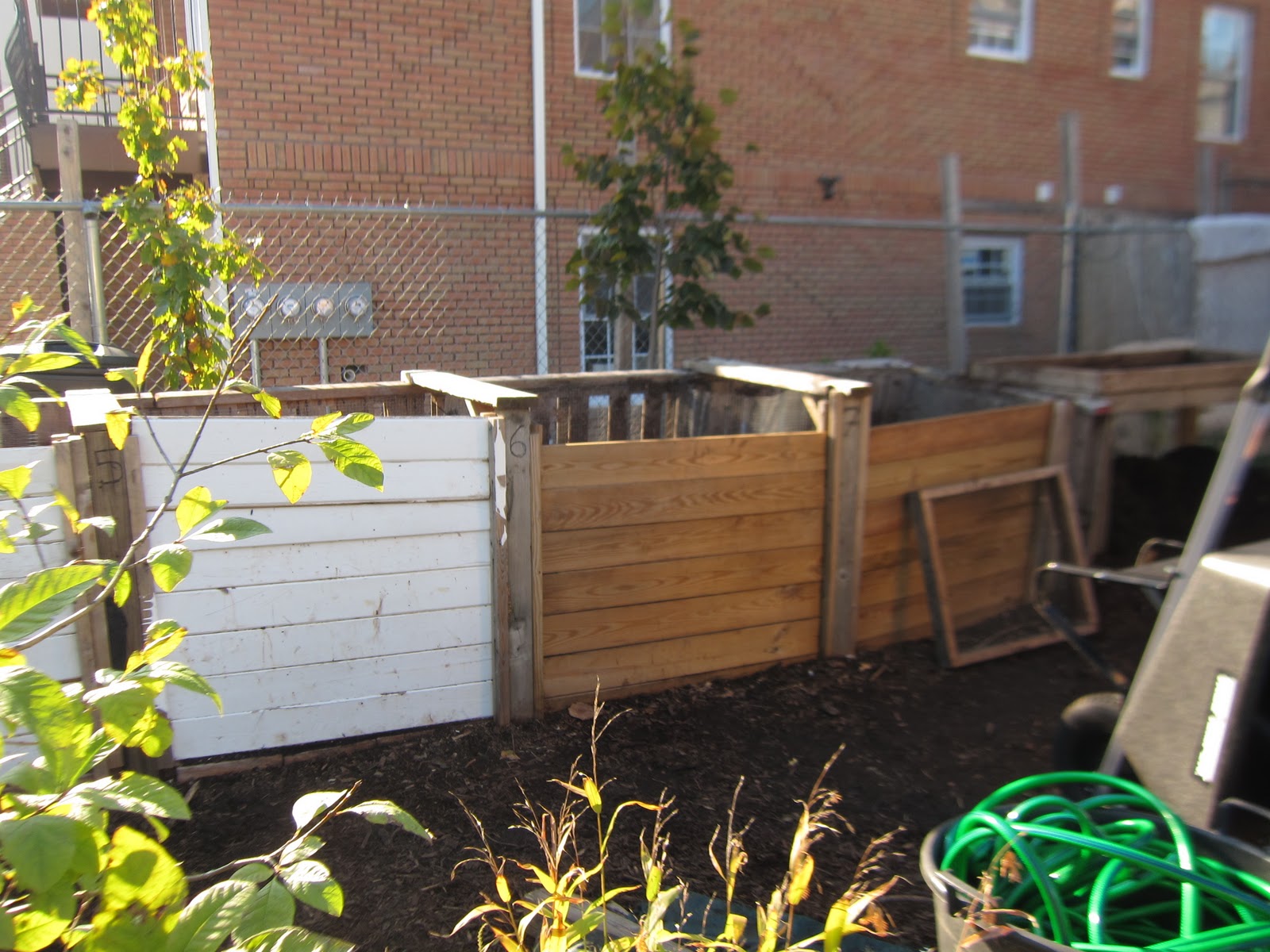
| 3 of the compost bins |
| Bins Buckets Shed Sifter Tumblers |
Friday, October 28, 2011
Bicycle Powered Water Pump for Rainwater Harvesting Systems
Making Community Gardens Sustainable is an ongoing theme of this blog and of the work I do during the time when I am not blogging. My most recent project was to devise a human powered water pump using a bicycle. Most community gardens do not have access to electricity to power a pump. A few might have solar panels to run lights or power other devices. Some may have access to electricity from the grid. But the numbers for electrified community gardens is small. Other solutions are necessary for the task of pumping water. I have already worked with an engineering intern to design a treadle pump for pumping water. An earlier blog post describes that effort.
Prototype drill pump on a bike blender
I felt this was a good solution but that creating a pump that worked with a bicycle might be even better for a number of reasons. Most people have a bicycle available to them and there are many used bicycles available for little or no cost. Bicycles and riding a bicycle are also more familiar to most people than a treadle pump. The bicycle could be used as a method of transport when not being used to pump water. Much like the treadle pump, using the bicycle to pump water would also be a form of exercise - a side benefit of this project.
Bike pump using bicycle trainer set up
There are some notable efforts at devising human powered machines. In most cases these efforts are being done in developing nations by international aid organizations or students. A very interesting group is Maya Pedal in Guatemala. They have devised many pedal power machines including corn grinders, nut shellers and wood saws. Youtube has many videos of bicycle powered devices, most often showing ways to generate electricity using a bicycle. That was one direction to work on but I wanted to use the bicycle to drive a pump directly rather than to produce electricity to run the pump.
Close up of the connection between the bike trainer and the drill pump
One idea I had was to use a drill pump. A small inexpensive device that can be attached to a power drill to pump out water in basements, swimming pools and other home uses. I just had to figure out a way to transfer the motion from a bicycle wheel to the drill pump. My first attempt was to use a bicycle blender setup to turn the drill pump instead of a blender. I made a prototype which worked but seemed like too much power was lost doing it this way.
Set up showing connection to the rainwater tank
I then realized that the bicycle trainer that kept the rear wheel off the ground could be adapted to turn the drill pump directly. I made a video that explains how it is done. I have to secure the drill pump and connector pieces better. In the video you will see that the pump is held in place by wires as a temporary solution. I will create a frame of some kind to secure the pump to the bicycle trainer. So it will be one unit easily moved or stored.
This is one small project that along with a number of other small projects can help make community gardens sustainable. With a little funding, hopefully several community gardens that can most use a bicycle water pump for their Rainwater Harvesting systems will get them this coming spring.
Prototype drill pump on a bike blender
I felt this was a good solution but that creating a pump that worked with a bicycle might be even better for a number of reasons. Most people have a bicycle available to them and there are many used bicycles available for little or no cost. Bicycles and riding a bicycle are also more familiar to most people than a treadle pump. The bicycle could be used as a method of transport when not being used to pump water. Much like the treadle pump, using the bicycle to pump water would also be a form of exercise - a side benefit of this project.
Bike pump using bicycle trainer set up
There are some notable efforts at devising human powered machines. In most cases these efforts are being done in developing nations by international aid organizations or students. A very interesting group is Maya Pedal in Guatemala. They have devised many pedal power machines including corn grinders, nut shellers and wood saws. Youtube has many videos of bicycle powered devices, most often showing ways to generate electricity using a bicycle. That was one direction to work on but I wanted to use the bicycle to drive a pump directly rather than to produce electricity to run the pump.
Close up of the connection between the bike trainer and the drill pump
One idea I had was to use a drill pump. A small inexpensive device that can be attached to a power drill to pump out water in basements, swimming pools and other home uses. I just had to figure out a way to transfer the motion from a bicycle wheel to the drill pump. My first attempt was to use a bicycle blender setup to turn the drill pump instead of a blender. I made a prototype which worked but seemed like too much power was lost doing it this way.
Set up showing connection to the rainwater tank
I then realized that the bicycle trainer that kept the rear wheel off the ground could be adapted to turn the drill pump directly. I made a video that explains how it is done. I have to secure the drill pump and connector pieces better. In the video you will see that the pump is held in place by wires as a temporary solution. I will create a frame of some kind to secure the pump to the bicycle trainer. So it will be one unit easily moved or stored.
This is one small project that along with a number of other small projects can help make community gardens sustainable. With a little funding, hopefully several community gardens that can most use a bicycle water pump for their Rainwater Harvesting systems will get them this coming spring.
Wednesday, October 19, 2011
Update on Community Garden and Urban Agriculture Plans and Policies
Cities across the US are beginning to be enlightened to creating ordinances, policies and zoning to allow
and even encourage urban agriculture and community gardening. A recent New York Times article
highlighted the fact that some cites particularly in the Midwest and Northeast have large numbers of
vacant lots with little demand from developers to build on them.
In some cases the policies are urban agriculture policies which are aimed toward allowing food
growing in urban areas as an entrepreneurial enterprise. In fact there was a flurry of activity this
spring as San Francisco passed what they are calling the "most progressive" urban agriculture
ordinance in the US. on April 14, 2011.
This policy was the result of advocacy work done by small urban farmers who wanted a positive
policy.
One day later Minneapolis adopted the first Urban Agriculture Policy Plan for that city. The
Minneapolis plan was crafted by a group of around 100 stakeholders.
Other cities are working on policies and pans including Oakland, CA, Chicago and Detroit. All
three cities have plans that are currently being debated.
As I wrote in previous posts, New York City passed a new rule about community gardens and
also passed Foodworks - comprehensive food policy that includes provisions for rooftop farms
as well as other healthy food initiatives.
Seattle has always been in the forefront having included community gardens in their city plans for
many years. The plan establishes a goal of one community garden for every 2,500 households in
the city.
and even encourage urban agriculture and community gardening. A recent New York Times article
highlighted the fact that some cites particularly in the Midwest and Northeast have large numbers of
vacant lots with little demand from developers to build on them.
This has been a problem for many years in Philadelphia and Cleveland.In fact,Cleveland has a very
strong Urban Agriculture policy. In fact it will be the topic of discussion at an upcoming October
Experts Panel Conference Call for ACGA Members with Morgan Taggart giving the Cleveland story
and Bill Maynard information about Sacramento's community garden friendly policy.
strong Urban Agriculture policy. In fact it will be the topic of discussion at an upcoming October
Experts Panel Conference Call for ACGA Members with Morgan Taggart giving the Cleveland story
and Bill Maynard information about Sacramento's community garden friendly policy.
In some cases the policies are urban agriculture policies which are aimed toward allowing food
growing in urban areas as an entrepreneurial enterprise. In fact there was a flurry of activity this
spring as San Francisco passed what they are calling the "most progressive" urban agriculture
ordinance in the US. on April 14, 2011.
This policy was the result of advocacy work done by small urban farmers who wanted a positive
policy.
One day later Minneapolis adopted the first Urban Agriculture Policy Plan for that city. The
Minneapolis plan was crafted by a group of around 100 stakeholders.
Other cities are working on policies and pans including Oakland, CA, Chicago and Detroit. All
three cities have plans that are currently being debated.
As I wrote in previous posts, New York City passed a new rule about community gardens and
also passed Foodworks - comprehensive food policy that includes provisions for rooftop farms
as well as other healthy food initiatives.
Seattle has always been in the forefront having included community gardens in their city plans for
many years. The plan establishes a goal of one community garden for every 2,500 households in
the city.
All of this policy activity bodes well for the legitimacy and longevity of community gardens and
urban agriculture initiatives. The next steps should be the creation of new community gardens
and urban farms, sharing of best practices among practitioners and support from all levels of
government, higher education and foundation that recognizes the importance of community
gardens to the environment and health of our cities.
urban agriculture initiatives. The next steps should be the creation of new community gardens
and urban farms, sharing of best practices among practitioners and support from all levels of
government, higher education and foundation that recognizes the importance of community
gardens to the environment and health of our cities.
Subscribe to:
Posts (Atom)