Search This Blog

Friday, March 23, 2012

The Process

It is often said that the process of reaching a goal is more important than the goal itself. As we try to create sustainable community gardens this is true with both the community and the gardening parts of community gardening. A group of people joining together to start a community garden will have to attend meetings to decide how to govern themselves and to develop rules and responsibilities of the members of the garden. This process can go a long way toward determining the success and longevity of the community garden. A contentious beginning may presage a future of ongoing conflicts in the group. An early series of meetings marked by cooperation and compromise could set the tone for a more harmonious future for the group.

A couple of projects I have participated in over the past few weeks have pointed out the importance of taking time and paying attention to the process in accomplishing garden improvement projects. Both projects take place at school gardens but the lessons learned apply for community gardens. At the Urban Assembly School for Green Careers school garden we embarked on a project to redesign and rebuild a garden shed that was in need of repair, to make the necessary repairs and turn the shed into a rainwater collector. Several meetings and many e-mails laid the groundwork needed to accomplish a complicated renovation. The existing roof had to be removed and the pitch of the roof changed to optimize the amount of rainwater collected. The students in the school were to take part in prefabricating the new walls and roof sections and in doing the demolition and reconstruction. Materials needed to be ordered and delivered on time and teacher and student schedules had to be arranged for the 3 day build.

One of the teachers at the school set up a blog to document the process from designing and prefabrication to the partial removal of sections of the roof and the walls. The blog posts tell the story in pictures and a little bit of commentary.

The other school project involves composting. Also an Urban Assembly school, The Urban Assembly New York Harbor School is located on Governors Island in New York Harbor. A 5 minute ferry ride from lower Manhattan is the only way to reach the school. The school's mission, includes making the students aware of the waterways surrounding New York City and the social, political and environmental issues which effect water quality, river and bay life and the workings of an active marine waterfront. Students go on to become ship captains and enter other water based careers in science, engineering and policy.

I visited the school to assess the possibility of using water conservation best practices by installing a rainwater harvesting system to water the school garden. What I saw in addition to the rainwater possibilities was a school wide composting program. The school has an Earth Tub composter which holds 3 cubic yards of organic waste. There is a whole process that has to take place in order to get the food waste and bulking agents into the composter.  Student interns collect buckets of food scraps from teacher rooms and the cafeteria and cart them outside to the Earth Tub. They have to chop the material into smaller pieces using hedge clippers. They also weigh the materials collected and log the totals, add wood shavings collected from the boatbuilding workshop, manually turn the tub, clean the buckets and return them to be refilled.

A "simple" part of a sustainable garden like composting takes a lot of planning and attention to process in order to make it a successful operation. Another example of how the process is in some ways even more important than the end result.

These two examples graphically show how important the process is in accomplishing a goal, a very important lesson from our schools to our community gardeners.

Sunday, February 26, 2012

Sustainability People

Sustainable Community gardens require many inputs. I can tick them off for you: water, soil, compost, seeds, pollinators, tools and labor. Since we are talking about what is primarily an urban activity we also have to include political and social sustainability. While labor and the physical inputs are important the more I research policy and permanency for community gardens, the issue keeps coming around to people. The passion and dedication of individuals in all of the input areas of community gardens is another major input that is usually overlooked. There are many dedicated individuals who spend countless hours volunteering in the gardens and attending meetings whose time and energy are crucial to the sustainability of community gardens.

In order to have a sustainable garden or farm, the soil has to have the necessary nutrients and structure for vegetables and fruit to flourish. If we want to have organic fruit and vegetables that means we have to have compost. In an urban area there is plenty of compostable materials; leaves, woody material, textiles, and food scraps are in abundance in most urban waste streams. In New York City that is 41% of household waste that can be recycled in source separated systems or in industrial compost systems. In tonnage that is 4920 tons per day. A very small percentage of that is being composted today but  PlaNYC has as a stated goal to create and expand systems to reduce the amount of materials being landfilled and composting can be a major part of this initiative.

Easy to make such a pronouncement but maybe not so easy to implement. There are a few small organizations and individuals that are dedicated to composting. Most have been doing organic waste projects for a number of years before PlaNYC. In fact PlaNYC is counting heavily on these folks to make this happen. Hopefully the municipal funds will be there to support these largely volunteer efforts. I have written here about Compost for Brooklyn and the Fort Greene Compost Project which was the pioneer group that showed how food scraps could be collected at GreenMarkets and composted locally. This has grown from a pilot at one greenmarket site to 11 sites. This project has collected 364,731 pounds in less than 1 year. Lower East Side Ecology Center has been composting local food waste since 1990 and continues to be a pioneer in setting up systems for organic waste recycling.

A relative newcomer to the city's neighborhood composting picture is the Western Queens Compost Initiative which brings me to the people part of the sustainability equation. Each of the projects I have listed is the brainchild and labor of love of one key person (often with assistance of hardworking volunteers). At Fort Greene it is Charley Bayre; at compost for Brooklyn, Louise Bruce; at Lower East Side Ecology Center, Christina Datz and at Western Queens, Stephanos Koullias. I spent a few minutes the other day speaking with Stephanos about the logistics of making this part of the sustainability equation work. The Western Queens Compost Initiative has set up an aerated static pile system to compost some of the Greenmarket food scraps. This is a low input system that seems to be ideal for urban systems. There is no need to turn windrows, so a tractor is not needed. It took a lot of coordination and dedication to the effort on the part of Stephanos to make this happen.

Even though compost will just happen if organic waste is left to it's own devices. In New York City that is definitely not the case. Without the people input of passion and dedication  these compost projects would not happen. In terms of creating a sustainable city and sustainable community gardens, compost is a key piece of the puzzle and the pivotal role of Community Gardening in sustainable systems is dependent on these dedicated sustainability people.

Sunday, January 22, 2012

Grow to Give: Lessons Learned

In what was another example of the maxim that one size does not fit all in terms of community garden policies, the Staten Island Grow to Give Conference for Community Gardens and Food Pantries highlighted how different the reality of community gardening is on Staten Island compared to the rest of New York City. This conference was held at the St. John's University Staten Island Campus with 64 people braving a minor snow storm to attend.


I was part of the planning committee and one of the lead organizers of the conference. The conference grew out of the Staten Island Hunger Task Force, where the task force group wanted to start more community gardens on Staten Island to grow more fresh fruit and vegetables for the island's food pantries. The task force members decided that a conference that brought together community gardeners, food pantry organizers and volunteer groups could be the catalyst to create more gardens on Staten Island and to link both the existing gardens and new ones to food pantries. There was also the need to address logistics for even the most basic need as getting the produce from the gardens to the pantries.


Originally we thought there were only 2 community gardens on Staten Island but through outreach for the conference that number reached 8. and around 30 food pantries.  Staten Island has the smallest population of New York City's 5 boroughs with just over 500,000 residents. One very active garden the Staten Island Moravian garden  actually was a perfect example of what the conference organizers wanted to see, a garden that donates produce to a local food pantry, Project Hospitality. Another community garden, the Roots of Peace Community garden, that started just last summer was on private land but received technical support from the Staten Island office of the New York City Department of Parks and Recreation. A little research by the director of the New York City municipal community gardening program, GreenThumb, revealed that there was only 1 vacant lot under the jurisdiction of the Housing Preservation and Development city agency (HPD) which was the source of most of the vacant lots that developed into community gardens in the other 4 boroughs of New York City. In comparison Brooklyn has 900 HPD lots. So any future gardens would have to be created on other vacant or underutilized land.

As the Castleton Hill Moravian Church showed, one possibility is church land. There are over 100 churches on Staten Island, many with underutilized land and some with food pantries. Despite the lack of city owned vacant land, there are many privately owned vacant lots as in the case of the Roots of Peace community garden and 2 others that were identified as community gardens on private property. Some of the new community gardens could be built on church or private land. Staten Island also boasts over 12,300 acres of protected parkland including federal, state and city parks. In fact one of Staten Island's community gardens is in Miller Field in Gateway National Recreation Area. Some of these acres parkland are underutilized land that could be turned into community gardens.

Volunteer  and other groups that could provide manpower were represented by groups like the Girl Scouts, Morgan Stanley and youth probation department.

This conference gave Staten Islanders a better picture of what community gardens exist today and how to get involved, how to start new gardens, where to look for land to start new gardens, how to connect to food pantries and what groups might provide helping hands. It also showed those of us who are concerned about community garden policies that even in a particular city, one policy does not fit all possible scenarios.


Thursday, December 29, 2011

Community Gardening : the Year in Review

This is the time of year that it seems like everyone has a list of top tens of everything and there are plenty of year in review stories. Here is my index of the year of the Community Gardening Blog. As I think back on 2011, I realize that a lot happened in the community gardening world, even more than I realized. Maybe that is why I haven't blogged as frequently as I would have liked; I was busy doing things. There were  a number of events starting with the New Jersey Community Gardening Symposium at the Frelinghuysen Arboretum but also including the annual spring events, Making Brooklyn Bloom and the GreenThumb GrowTogether as well as the ACGA conference held in New York City this past summer.

There was a lot of discussion and a lot written about plans and policies for community gardens and urban agriculture. In New York City we had a new "Rule" which passes for policy in this complicated city but of course isn't. So far there have not been any tests to see whether the Rule is strong protection for the gardens or not or what changes can be added to make it stronger. If this was a blog predicting what will happen in 2012, I would say that we will hear a lot more about this Rule. I can guarantee that you will hear and read more from me about policies in 2012.

With all of the talk of spending cuts coming from Washington and Albany there was on again and off again threat, worry and angst about whether the GreenThumb program will be cut a little, a lot or drastically. Nothing has happened yet although at this time it seems the cuts may just be a little. One of our wishes for 2012 is for more funds instead of cuts for GreenThumb. If only we has better news to report about the New York State Community Gardening Program. The coordinator left at the end of the summer for a new (not state) position and no one there answers the phone or replies to voice messages. The future for that program does not look so rosy.

We may have to include the New York State Community Gardening Program among those we have lost this year. We also marked the 25th anniversary of the loss of Adam Purple's Garden of Eden which was the first community garden loss that made headlines. Another of the wishes for 2012 is that there won't be any community garden losses in 2012 but rather a lot of new gardens about which I can report. An updated survey of community gardens will be released this year which should show increased numbers of community gardens in most cities from 1998 when the last survey was released. I know there will be a local conference 'Grow to Give' in Staten Island on January 21st to encourage more community gardens on Staten Island and to make the connections between volunteers, land and resources with the hope of growing more produce for Staten Island food pantries.

A number of 2011 posts were devoted to my early years in community gardening traced through the creation of the  6BC Community Garden.  That is something that I have been wanting to write about for many years and I am happy that I had the opportunity to share with you. I hope there will be more to add to the story in 2012, both stories from the past and new stories to come.

It was great to visit Compost for Brooklyn and add Community Compost Garden to the list of possibilities for community gardening. The Occupy Wall Street Movement inspired moving the Bicycle Water Pump from a germ of an idea to a working model. There will be pictures of these pumpers to show in a number of community gardens this season. Compost for Brooklyn needs a human powered leaf shredder. I wonder how that will work??  In addition to the Bicycle Water Pump, Occupy Wall Street also helped to show the world about the importance of process and developing a political and social structure that is inclusive. It reaffirms what I have written about the sustainability of community gardens being as dependent on the social sustainability of the garden group as it is on the physical space.

Not quite your traditional index, year in review, new year predictions or memorials but all rolled into one with the good news and bad and the hopes and dreams for next year which is only 2 days away. There are many reasons to believe that 2012 will be full of accomplishments and forward movement in community gardening and the work we have done this year will be a strong foundation on which to build. Blog with you next year!

Wednesday, December 14, 2011

New Survey of Municipal Urban Agriculture Policies and Zoning

"Urban Agriculture: A Sixteen City Survey Of Urban Agriculture Practices Across the Country", a recently published report by the Turner Law Clinic of Emory Law School assesses Urban Agriculture zoning, policies and plans. There is bad news and there is good news in the report. The bad news is that there is not a best municipal zoning code or one size fits all of policies or plans. The good news, there is not a best municipal zoning code or one size fits all of policies or plans. 


To begin with, all of the cities had different definitions of urban agriculture, community garden or urban farm which may go a long way toward explaining why there is no agreement on policies and zoning. The reason this is good news is that since most US cities are very different in terms of geography, population, politics and openness to change or even to the idea of planning, it makes sense that they would come up with different urban agriculture policies (or in some cases none at all). This makes it likely that the zoning or policy for any given city will be well suited to that city's unique situation.  For any municipality that wants to come up with a plan for urban agriculture there will be some hard work ahead.


One of the good news items is that the the authors give us 16 examples of what has been done or is in the process of being enacted. So municipalities can start with some ideas to work toward crafting a policy that works for their city. Others have done some groundwork for them. The bad news here is that the authors do an uneven job in their reporting. Some cities are covered in great detail, while others much less so. Emory's hometown of Atlanta is well covered but in other cases that may be because there is more to report on for certain cities like Minneapolis which is way ahead of most cities in this process. In one way that is not surprising  because there is a tremendous amount of involvement by the citizens of Minneapolis in the planning and policy making process. Normally I would think that having too many people involved in the process can bog down progress but the good people of Minneapolis have defied that logic. 


Citizen involvement is strong in many cities where the urban agriculture and community gardening movements are thriving in spite of the lack of support from the municipality. Detroit is a perfect example of this phenomenon since it probably has the greatest amount of acreage devoted to urban agriculture of any American city because of it's wealth of vacant land, urban farming advocates and practitioners. At the same time there are no municipal urban agriculture zoning laws or policies in Detroit, ironically because of a state 'Right to Farm' law. 


One would think this would be a good thing for urban agriculture but the law was written to protect farmers from local attempts to curb their livelihood as the citizens of Detroit abandoned the city for the suburbs and their suburban sprawl began encroaching on farmland. One of the provisions of the law was that no government more local than the state could enact any legislation about local agriculture. So Detroit will have to get an exemption from the law in order to be able to create urban agriculture zoning regulations.


This points out how difficult it is to enact zoning or policies. When zoning or policies are created to promote urban agriculture the definitions can inadvertently place unintended limitations on urban farmers or community gardeners. In fact the authors do mention that at least some groups that they interviewed liked the fact that there was no policy because it meant (and I'm reading between the lines here) there was little notoriety about what they were doing as well as little regulation. When there are regulations there tend to be permits, fees, reporting and other added tasks and controls for the community gardener or urban farmer.


There are bits of great news in this report, for example Atlanta is committing to building urban agriculture or community garden plots in every city park and all San Francisco city departments have been instructed to support urban agriculture. Two things that every city should copy and paste into their policies.


Of course I am most familiar with NYC and have written about the permanency battles here in previous posts. The reporting on New York City takes most of the 'facts' from just 2 websites so the history is glossed over and a bit inaccurate. For instance New York Restoration Project get all the credit for purchasing and preserving community gardens in land trusts when more than half of the community gardens were saved by Trust for Public Land.


Overall this is an important document that has moved the knowledge base forward on this issue. The authors even admit that it is a moving target - a number of cities were in the process of creating new zoning codes or policies and updates will have to happen frequently to keep information up to date. It is definitely worth reading.


The good and bad news continues when I think that 20 years ago I wrote a report that only found 4 cities (NYC was not one of them) with zoning, policies or plans and now this report includes 16 - good - but it seems most of the work has been done in the last 2 years.


The best news of all is that community gardening and urban agriculture is thriving in many cities because of the hard work of the residents doing the gardening or farming whether or not there is support from the city. In many cases the impetus for all of this legal work comes from the ground up from many of the same folks. To me this gives even more importance to making sure that there is social sustainability for community gardening and urban agriculture groups.

Monday, November 28, 2011

Design for the Other 90% : Cities

Last week I had the privilege of visiting the exhibit Design for the Other 90% : Cities part of a continuing series of exhibits by the Cooper - Hewitt Museum that highlight design solutions for the 90% of the world's population that usually don't receive the benefits from designers working on products and systems to improve their standard of living. This exhibit is at the United Nations, a fitting venue.

The exhibits were models, full size objects, videos, photos and informational boards that focused on public health, clean water, food access, energy and transport. The designs were created for what are termed informal settlements, groups of people forced to resettle because of famine, war, natural disasters or just the search for a better life. These settlements often have poor housing, sanitation and lack of drinking water.  While not on the same scale  some of the same issues we discuss in reference to the sustainability of community gardens.

One of the exhibits highlighted access to food with a design for a "Garden in a Sack". The sacks are filled with loamy soil and manure, slots are cut on the sides and seedlings planted in the slots. Families can harvest as many as 4 meals per week from their planting. Community groups are adopting the technique in a type of community garden. In some cases they grow enough to sell at market. See my previous posts on Vertical Gardening - growing vegetables in recycled polyester bags from April 15, July 12 and September 26, 2010.
I am also very interested in the use of human power to accomplish tasks that are needed in a garden. Several of the exhibits highlighted using bicycles for transport or producing electricity. One exhibit showed full size examples of a modular bicycle frame that can be used to make a bicycle with a piece of wood or a cart using the same frame. See the included photos.

Another design  uses the bicycle to power a charger for a cell phone.
There was a design that used bicycle pedals to pump water from a water tank through a filter system.

For a view of another system, I made a new video showing the improvements I have made to my design for a bicycle water pump.

This exhibit is well worth a visit if you are in NYC. There is also a detailed website worth exploring and a catalogue that can be purchased through the website.

Tuesday, November 15, 2011

Community Compost Garden

C4B Bike Trailer
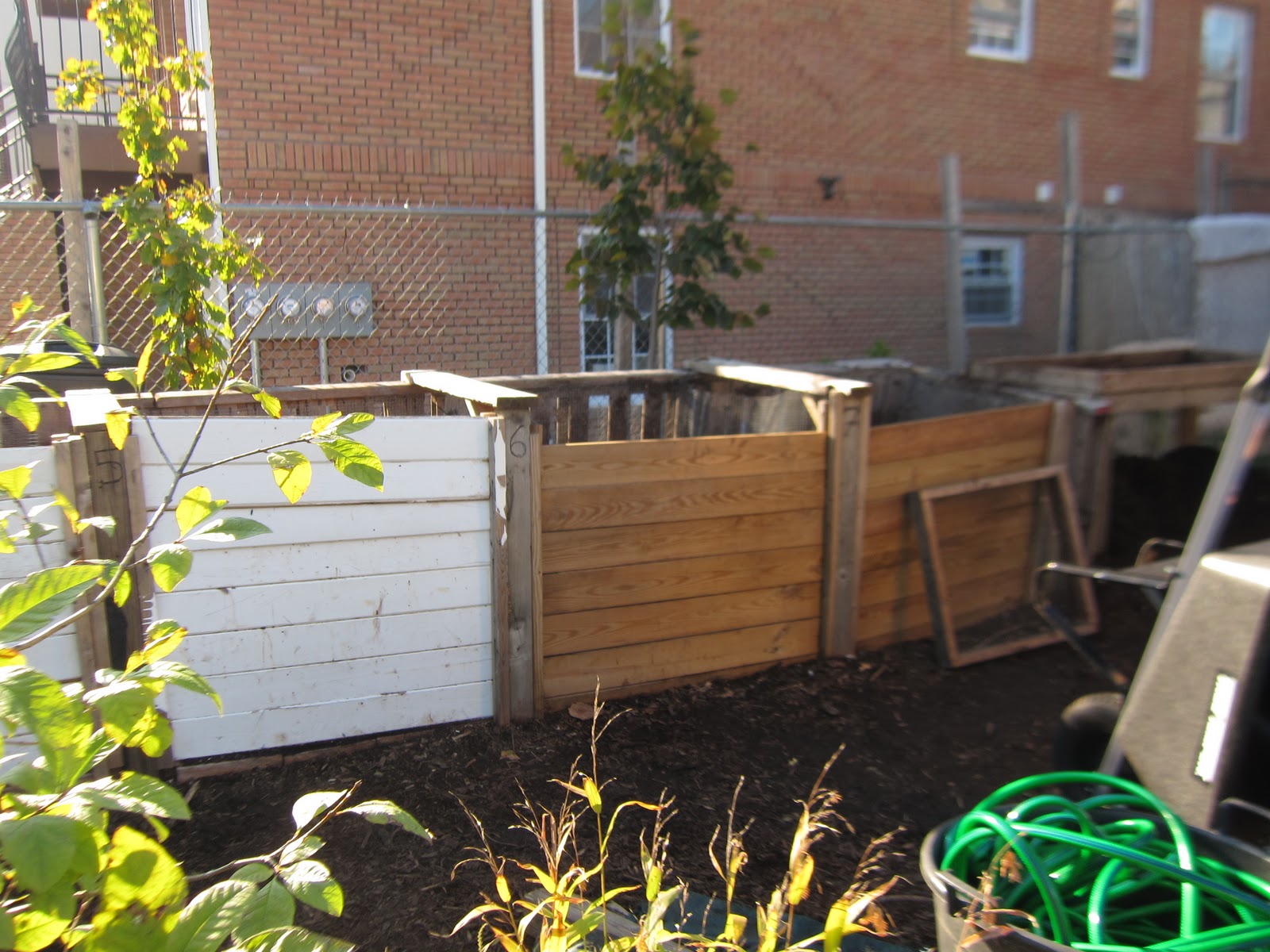
The title of this post could have been Compost Community Garden or Garden (of) Community Compost but I chose Community Compost Garden. Let me explain. I recently visited the Compost for Brooklyn   or C4B garden, a site that I have heard much about but have never had the chance to visit. On a tiny - 45 X 50 foot lot, a small group has converted a vacant space to a very productive one. The space has a dozen compost bins, a couple of compost tumblers, a large compost sifting table and a small shed that collects rainwater. There are also native plantings scattered around the garden.
Browns and Greens
This project is the brainchild of Louise Bruce, a young woman I met a couple of years ago when she was a member of the Green Apple Corps (GAC), an environmental training program that is part of the Dept. of Parks in NYC. The GAC assisted me in the construction of a number of rainwater harvesting systems but Louise's passion was composting. She was able to convince a private landlord to allow her and a small group of helpers to take this vacant lot and turn it into a community compost center.
Rainwater Harvesting Shed
Their first fall they accepted lots of leaves that have turned into the soil base of the garden. They got help from a local woodworker who not only donates his wood shavings (which are a perfect 'brown' to add to all of the 'green' they receive) but also built some of the compost bins for the group. This is a perfect example of the cooperative nature off this undertaking. They not only encourage folks to drop off their vegetable scups from home but welcome and encourage volunteers to help with turning piles, sifting the finished compost and picking up donations from the local Community Supported Agriculture group and Greenmarket. Workshops and assistance are offered for folks who want to compost at home and they teach  a program for children they call Bug Land Builders which teaches kids about the good insect decomposers and pollinators.
Community Compost Sifter
While not a typical example of a community garden, C4B is a great example of a sustainable community garden. A group has taken an underutilized space and turned it into a productive one. Productive not only in the sense of creating a usable product - compost - but also producing community. When I spoke to Louise during my visit, much of our conversation was about the people involved and how she is working hard to create a sustainable community group.
3 of the compost bins
All of the physical sustainable things C4B is doing; making compost, harvesting rainwater, using a cargo bicycle to transport compostable materials all contribute to the social sustainability of this project. People are engaged by doing and learning and future ecologists are being trained.
Bins Buckets Shed Sifter Tumblers
New York City has no landfill or incinerator within it's boundaries. All waste is shipped out of the city. Much has been written about how to solve the solid waste problems that face our cities. Backyard or small scale composting is not considered to be one of the answers. I am sure those folks have not seen Compost for Brooklyn. They might think differently if they did. Anyone who wants to do this kind of project I would recommend modeling your project after C4B. Oh and no smell or signs of vermin!