Attending the community gardening conference last month in New York City, gave me the opportunity to share ideas and make connections with other community gardeners. It also provoked some thoughts and ideas. From the large proportion of sessions devoted to research it became clear that the glaring omission was the lack of a national survey and census of community gardens. In fact I spent a little time at the conference talking to folks about what that might look like and how it might be done. I plan to spend some time in the coming months working on that project. such a survey could pinpoint where there are opportunities for more community gardens.
On a Tour at the Conference
The overwhelming interest in community gardening from around this country and the world makes one think about the big picture. Shouldn't cities plan in advance for community garden or urban agriculture spaces? Particularly cities that have vacant land because population has declined but also cities that are growing that have the opportunity to set aside space for community gardens before that space is is built upon. Both types of cities can develop policies to encourage and promote community gardens.
A narrow lane in a village in Sicily
A recent New York Times article focused on Cleveland as an example of a city with available land and shrinking population. While the article focuses on a study of the benefits of a vacant lot in terms of habitat and biodiversity, my interest piqued when the article mentioned the opportunity for cities to do something positive with the land. While at this time cities like Cleveland and other Northeast (Philadelphia) and Midwest (Youngstown, OH) cities are losing population to the Southeast and Southwest, there may come a time when the Southern cities will have reached their limits to growth particularly because of lack of drinking water. With the ongoing drought conditions in these regions that time may be very soon. And that will be a time when the Northern cities could increase their populations in a well planned manner that includes adequate open space and room for community gardens and urban agriculture.
Melons being sold off the back of a truck in Sicily
I can see redevelopment of neighborhoods in a sustainable way that takes into account transportation, commerce, agriculture and recreation in addition to housing. These neighborhoods could and should have as small a carbon footprint as possible. I just returned from a vacation in Sicily and I was struck by 3 things. One was the incredible beauty of the land. Second was how tasteful the food was. Not just the cooked food but even the raw ingredients. Peaches and Melons were in season and the flavor of the fruit was much stronger and fresher than the same fruit in season here. Was it that it was local? Third was that all of the towns were densely built with narrow roads and attached buildings everywhere. Of course the Sicilians love their (mostly very small) cars so there was traffic even in these small towns. But there was also alternative transportation. As much of the land was hilly, I rode in cable cars called Funuvia on 2 occasions. Olive trees and Grapes grew everywhere and particularly just outside of the towns were small farms. Could these small towns be models for what these new neighborhoods could be?
Community Gardening in all of it's manifestations is a proving ground for experiments in social and ecological sustainability. Read How.
Search This Blog
Sunday, September 11, 2011
Sunday, August 21, 2011
ACGA Conference Report
The 32nd annual American Community Gardening Association (ACGA) conference was a rousing success on many fronts. Attended by over 350 people from 30+ states as well as 7 other countries. Workshops, a trade show and a day of tours meant that there was a variety of opportunities for folks to learn, teach and network.
At least 1 person who read this blog learned about the conference, received a scholarship, attended the conference and ended up sitting next to me by chance at the keynote speech. That speech and a significant percentage of workshops focused on research which shows me how far the community gardening movement has come from the first conference I attended 25 years ago.
I had the opportunity to connect with old friends and colleagues and lay the groundwork for future projects. I met folks who work with or have followed in the footsteps of former colleagues. I spoke with other New Yorkers who I have never met before that are working on parallel or complimentary projects. I chatted with someone who was on a bicycle tour of gardens I led at the conference in 2002. I ended the day Saturday pretty hoarse from leading a tour of Gardens in the Bronx that have a connection with public schools. The photos here are from that tour.
All in all a tiring yet exhilarating experience. Next year San Francisco!
Saturday, August 6, 2011
It has been awhile since I last posted the story of the 6BC Garden and the early years of my involvement with community gardening. Today I happened to visit the garden after riding my bike on car - free streets in Manhattan called Summer Streets . Lafayette Street and Park Avenue were closed to cars from 7am to 1pm from the Brooklyn Bridge to 72nd Street. There aren't any community gardens on the route but a few blocks off the route in lower Manhattan are many community gardens including 6BC. The garden looked wonderful as always. People were strolling in and out just to have a look or to sit with friends.
To continue the story... Folks who were the garden leaders at the time were very concerned about preserving the garden knowing the lurking threat of Mayor Giuliani's policy of ridding the city of all "vacant property". I moved from my Lower East Side apartment so I was no longer an active gardener but I continued to advise and assist the garden group whenever I could. The gardeners realized that the assemblage of lots that encompassed the 6BC and adjacent 5th Street Slope gardens was large enough for a fairly large - 60 - 100 - multi - unit dwelling so would be coveted by developers. They put together a wonderful document outlining the history and value of the garden with photos, press clipping and other documentation. Much of this document can be found on the garden website. This process and some behind the scenes work on my part resulted in the garden being transferred to the Parks Dept from the Departments of Housing Preservation and Development and General Services along with about 35 other gardens deemed worthy of protection. While good news for the 6BC garden there was also a lot of discussion and anger among gardeners who felt that there was favoritism and an unfair and non transparent process for choosing which gardens would be transferred. The transferred gardens it turned out were also protected from the Giuliani plan to auction 120 gardens.
The transfer to the Parks department emboldened the gardeners to solicit city capital funds from the local city council person to get new fencing and an in ground water system which they received. As is often the case with large sums of money, this funding began a rift between the 2 adjacent gardens which continues to this day. Despite efforts by a number of people to bring the 2 gardens together as one, personality and racial conflicts kept the gardens from uniting. The City Council funding was earmarked for the whole assemblage though at the time the 5th Street side was much less developed as a garden. A parking lot run illegally by a local man who took many years to evict kept the gardeners from gardening on two thirds of the lot. The 6BC gardeners used this opportunity to have the back-flow preventer and control box placed on the 5th Street side because it took up garden space and was unsightly. But since there was still a fence between the 2 gardens, the 5th Street gardeners refused to allow the 6th Street gardeners access to the water - a situation that continues to this day. All of the money for fencing was spent on an elaborated wrought iron fence - on the 6th Street side.
The garden development continued with a new 2 storey shed built with a small tea room on the upper level (which had to be rebuilt after a suspicious fire destroyed part of the structure), a large pond was installed which was aerated by a pump powered by solar panels on the shade structure. A sunken seating area was built with stone salvaged from building sites around the neighborhood - a building boom was taking place throughout the 1990's until 9/11. A smaller pond and a Japanese style arbor create a theme garden vignette. The pathways were meticulously laid with recycled brick from the garden into intricate patterns and the garden name at the gate. An herb garden originally planted over 20 years ago remains with some original and some newly added plants. The garden has become almost entirely ornamental, in fact the official name is the 6BC Botanical Garden. There was even a cactus garden where during the summer months a number of cacti were grouped together and kept alive by bringing them indoors in the winter. The garden hosts a number of events like poetry readings, solar workshops, music, dance and private events.
A visitor today will find a beautiful peaceful garden with folks weeding, watering and maintaining this gem of a space. They won't of course know any of the back story of how the garden went from a vacant lot to a lush landscape or the work that went into building the structures or the infighting and inter-garden conflicts. For me I am proud of the work that I did in the garden, not so happy about failed attempts to merge the two gardens and embarrassed by the actions of some of the gardeners that created a permanent rift between gardens. This is just one story of thousands that could be told of the community gardening process that is not always pretty but one where folks have to work together to accomplish something. Community Gardening is much more about community, social interaction, psychology, economics and politics than it is about gardening.
Tuesday, July 19, 2011
American Community Gardening Association
The American Community Gardening Association (ACGA) is holding it's 32nd Annual Conference at Columbia University in New York City from August 18 to August 21st. For anyone interested in community gardening, I highly recommend attending this conference. It is a great opportunity to learn though workshops, network with 400-500 community gardeners and community gardening professionals, visit some of the most interesting community gardens in the world and spend some time in New York City.
My community gardening experience is directly tied to the ACGA conferences in many ways. I attended my first conference in New York City in 1985 and found a job announcement advertising the position at Council on the Environment which became my job a few months later. I have attended 16 other conferences which together have been a bi-national tour of cities in the US and Canada. I've had the pleasure of visiting Seattle, Philadelphia, Milwaukee, Cleveland, Denver, Louisville, Chicago, Montreal, Indianapolis, Dayton, Atlanta, Toronto, Minneapolis/St.Paul and Los Angeles. Community Gardens in each city reflected the flavor of the city and region as well as ethnic and immigrant cultures inhabiting that city.
For 6 years in the early to mid 1990's I served on the ACGA Board of Directors, most of that time as the Chair of the Publications Committee responsible for publishing the Community Greening Review. Of course those were the days before ACGA had a website and the board members were pioneering a new way to communicate between semi-annual meetings called e-mail. The Community Greening Reviews did provide in depth articles about community gardening at a time when very few researchers were studying and writing about the subject. These articles served as seminal works that have informed and inspired the current generation of researchers.
At several conferences I presented workshops on Council on the Environment programs, rainwater harvesting and community garden mapping. This year's conference has workshops on youth gardening, sustainability, advocacy and community development. The workshops are informative and helpful but the most interesting part of ACGA conferences are the garden tours. The pictures included in this blog post were taken on some of those garden tours. The tours at this conference are by bus, bike and foot, are all themed, include a workshop or service component related to the theme and lunch in one of the gardens. To truly appreciate New York City community gardens it is best to visit them. I will be leading a bus tour of community gardens in the south Bronx that have a connection to schools in the neighborhood.
For anyone who has an interest in community gardens, school gardens, urban agriculture, sustainability or community building, the ACGA conference has all of that and more. Who knows it could lead to a job, an avocation as a presenter, an election to the ACGA Board of Directors or even to a Blog!
Aspen Farms, Philadelphia, 1999
My community gardening experience is directly tied to the ACGA conferences in many ways. I attended my first conference in New York City in 1985 and found a job announcement advertising the position at Council on the Environment which became my job a few months later. I have attended 16 other conferences which together have been a bi-national tour of cities in the US and Canada. I've had the pleasure of visiting Seattle, Philadelphia, Milwaukee, Cleveland, Denver, Louisville, Chicago, Montreal, Indianapolis, Dayton, Atlanta, Toronto, Minneapolis/St.Paul and Los Angeles. Community Gardens in each city reflected the flavor of the city and region as well as ethnic and immigrant cultures inhabiting that city.
Mr. McGregors Garden, Dayton, 1997
For 6 years in the early to mid 1990's I served on the ACGA Board of Directors, most of that time as the Chair of the Publications Committee responsible for publishing the Community Greening Review. Of course those were the days before ACGA had a website and the board members were pioneering a new way to communicate between semi-annual meetings called e-mail. The Community Greening Reviews did provide in depth articles about community gardening at a time when very few researchers were studying and writing about the subject. These articles served as seminal works that have informed and inspired the current generation of researchers.
Wattles Garden, Los Angeles, 2006
At several conferences I presented workshops on Council on the Environment programs, rainwater harvesting and community garden mapping. This year's conference has workshops on youth gardening, sustainability, advocacy and community development. The workshops are informative and helpful but the most interesting part of ACGA conferences are the garden tours. The pictures included in this blog post were taken on some of those garden tours. The tours at this conference are by bus, bike and foot, are all themed, include a workshop or service component related to the theme and lunch in one of the gardens. To truly appreciate New York City community gardens it is best to visit them. I will be leading a bus tour of community gardens in the south Bronx that have a connection to schools in the neighborhood.
Community Garden, Minneapolis, 2005
For anyone who has an interest in community gardens, school gardens, urban agriculture, sustainability or community building, the ACGA conference has all of that and more. Who knows it could lead to a job, an avocation as a presenter, an election to the ACGA Board of Directors or even to a Blog!
Miracle Garden, New York City, 2010
Thursday, July 7, 2011
Water, Water Everywhere But...
On several occasions this spring I received e-mails or phone calls saying that the water in their rainwater harvesting (rwh) tank smelled like a sewer or a swamp. Folks were worried that something was wrong and wondered whether they should use the water or not. The water in my rwh tank at home also smelled swampy for a short time.
Water quality is a major concern not just for rwh systems but for water systems throughout the world. Public water systems as well as municipal systems that have been privatized have to be monitored constantly and on occasion have to issue drinking water alerts. The New York City drinking water supply which is considered one of the finest, best tasting water but the city is building a filtration plant to filter the 10% of the water supply that comes from the highly developed Croton reservoir area at a projected cost of $3 billion.
The quality and cleanliness of natural water systems - our rivers and lakes is also of concern. In fact one of the benefits of rwh is in helping to prevent combined sewer overflows that can happen in a rainfall of as little as one tenth of an inch. Combined sewers handle both sanitary sewage, the waste from our toilets, sinks, washing machines, showers and tubs as well as the rainfall that runs in the city's gutters. In a combined sewer overflow event, the added rainfall overwhelms the capacity of the sewage treatment plant and all of the liquids and solids are sent into the river.
The concern about water quality in rwh systems is something that we have considered and tested. Because of the many variables to consider and the cost of testing we were only able to test water quality at 1 community garden. The results can best be summed up by a quote of mine that appears in the August / September 2011 print issue of Organic Gardening Magazine.
"You can’t really generalize,” he says. You can’t compare an asphalt roof in an urban area with a rural one where birds regularly roost. “The [varying] amount of rainfall and frequency means that if you tested the water in your barrel each time it rained, you would get a different result.” Since testing is prohibitively expensive, Librizzi adds, “I tell folks if they are uncomfortable with watering their edibles with collected rainwater, they should use it only for ornamentals. They will still be saving water.”
So, the swampy smell. Since none of the water was tested, I can only make an educated guess. I think what happened was that we had a couple of significant rains in the spring which meant that a lot of organic material such as pollen, flower parts and seed parts found their way into the tanks. The weather warmed up to heat this mixture and the aerobic environment turned into an anaerobic one much like in a swamp.
However or whether the community gardeners used the collected rainwater, water was diverted from the combined sewers, helped to keep our waterways clean and helped to conserve water. There are now over 80 rwh systems in NYC community gardens (it is hard to keep track of the number as new ones are added frequently- some that I am not even aware of). My best educated guess is that all of these rwh systems collect approximately 1 million gallons of rainwater each year!
Water quality is a major concern not just for rwh systems but for water systems throughout the world. Public water systems as well as municipal systems that have been privatized have to be monitored constantly and on occasion have to issue drinking water alerts. The New York City drinking water supply which is considered one of the finest, best tasting water but the city is building a filtration plant to filter the 10% of the water supply that comes from the highly developed Croton reservoir area at a projected cost of $3 billion.
The quality and cleanliness of natural water systems - our rivers and lakes is also of concern. In fact one of the benefits of rwh is in helping to prevent combined sewer overflows that can happen in a rainfall of as little as one tenth of an inch. Combined sewers handle both sanitary sewage, the waste from our toilets, sinks, washing machines, showers and tubs as well as the rainfall that runs in the city's gutters. In a combined sewer overflow event, the added rainfall overwhelms the capacity of the sewage treatment plant and all of the liquids and solids are sent into the river.
The concern about water quality in rwh systems is something that we have considered and tested. Because of the many variables to consider and the cost of testing we were only able to test water quality at 1 community garden. The results can best be summed up by a quote of mine that appears in the August / September 2011 print issue of Organic Gardening Magazine.
"You can’t really generalize,” he says. You can’t compare an asphalt roof in an urban area with a rural one where birds regularly roost. “The [varying] amount of rainfall and frequency means that if you tested the water in your barrel each time it rained, you would get a different result.” Since testing is prohibitively expensive, Librizzi adds, “I tell folks if they are uncomfortable with watering their edibles with collected rainwater, they should use it only for ornamentals. They will still be saving water.”
So, the swampy smell. Since none of the water was tested, I can only make an educated guess. I think what happened was that we had a couple of significant rains in the spring which meant that a lot of organic material such as pollen, flower parts and seed parts found their way into the tanks. The weather warmed up to heat this mixture and the aerobic environment turned into an anaerobic one much like in a swamp.
Sunday, June 26, 2011
Community Gardening Yeasayers and Naysayers
I regularly come across news items that either highlight the benefits of community gardening, are feel good stories about community gardening or are in some way negative about community gardening. Sometimes the news items make great counterpoints to each other like these.
I have been an advisor to Project Grow school gardening project at City as School H.S., an alternative public high school in lower Manhattan. For many years they had a garden and greenhouse in the entry plaza to the school. Last year, the greenhouse and garden had to be removed to make way for a renovation project to the school's facade. The school has no other usable space but currently they are gardening in a mini-farm at Battery Park. Some of the students created an interesting video about their project. Definitely Yeasayers. Please note that Battery Park is 25 acres of Parks Department parkland in Manhattan.
Another article I came across : "Senior Citizens' Illegal "Vegetable" Garden Destroyed In Highbridge Park" was about a group of seniors in Upper Manhattan that were growing vegetables in an underutilized area of Parks Department land in Upper Manhattan. Now, the seniors seemed to have neglected to ask permission -maybe they forgot, maybe they wanted fresh local vegetables like the aforementioned downtown Manhattan dwellers or maybe they were a group of guerilla gardeners. I don't know what their motivation was but it does point out that there is a demand for space to grow vegetables in NYC.
There was a disturbing comment from Manhattan Parks commissioner William Castro in the article which appeared in the on-line Gothamist weblog, "'we almost never get a request for' vegetable gardens.". Definitely a Naysayer. By the way, GreenThumb is the largest municipal community gardening program in the US, is part of the Parks Department and does issue licenses to nearly 300 groups to grow vegetables on land under the jurisdiction of the Parks department.
One more Naysayer: A Harvard professor, Edward L. Glaeser, wrote an op-ed piece in the Boston Globe with the subtitle "Urban farms do more harm than good to the environment". His argument is that more urban agriculture = lower population density= more driving= more energy use. I guess on the surface this argument makes sense except that no one is talking about depopulating cities in order to grow more food within city limits but rather utilizing unused spaces like vacant land and rooftops. I don't think that most cities will be able to grow a high proportion of the food they consume. The point is to grow as much as possible particularly items that provide high nutrition values using the most sustainable farming practices. Yes, I am a Yeasayer!
Monday, June 6, 2011
Community Garden Version of the High Line and More
Today I visited the Long Island City Roots Community Garden which is built on a former rail siding that ran in this industrial area of Queens, NY. The rail is not exposed in the garden but their are tracks visible outside of the garden. I was told to follow the tracks west as they appeared and disappeared to get to the subway entrance to return to my office. There is a new garden which has sprouted on the tracks.
It is the Queens version of the High Line, an elevated former rail line on the west side of Manhattan. The second phase of the project which will add an additional 1/2 mile to this linear park will be officially opened on June 8th. While this project has a price tag of several hundred million dollars, This Queens "Low Line" while not so ambitious has probably cost pennies. A few pics:
I also took a few photos of the Morris Jumel Garden in Washington Heights, Manhattan. They have an interesting Rainwater Harvesting system that collects the rain in a raised barrel with a lower one serving as overflow and a barrel to fill a watering can.
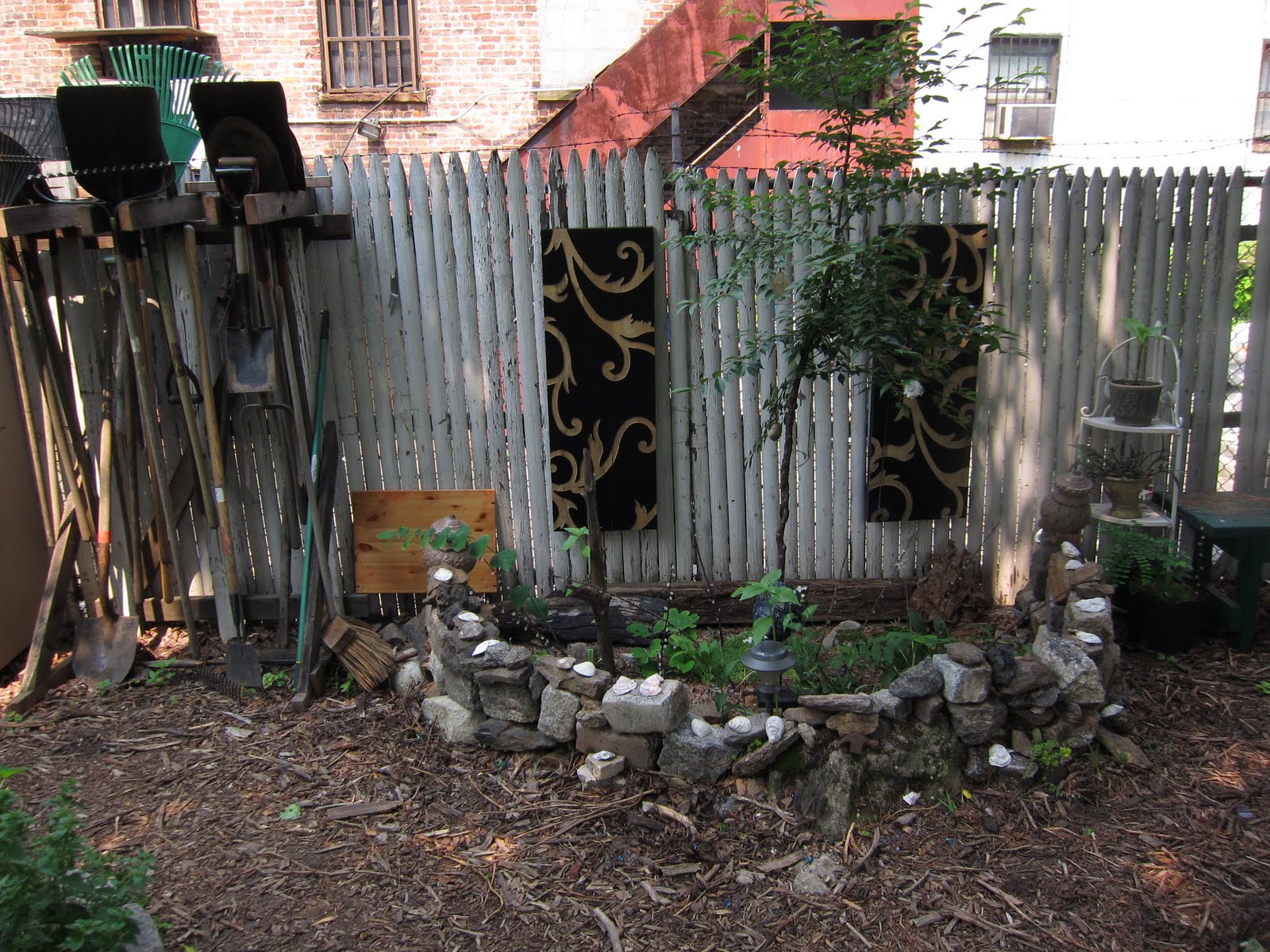
There were interesting little vignette gardens / sculptures.
It is the Queens version of the High Line, an elevated former rail line on the west side of Manhattan. The second phase of the project which will add an additional 1/2 mile to this linear park will be officially opened on June 8th. While this project has a price tag of several hundred million dollars, This Queens "Low Line" while not so ambitious has probably cost pennies. A few pics:
------------------------------
-------------------------------
There were interesting little vignette gardens / sculptures.
A metal sculpture with mannequin leg
-------------------------
A neat assemblage including an outdoor tool rack
-----------------------
And from the All Peoples Garden in the Lower East Side of Manhattan, a beautiful new photorealistic mural of the garden's founder Olean For:
Subscribe to:
Posts (Atom)