Search This Blog

Thursday, July 7, 2011

Water, Water Everywhere But...

On several occasions this spring I received e-mails or phone calls saying that the water in their rainwater harvesting (rwh) tank smelled like a sewer or a swamp. Folks were worried that something was wrong and wondered whether they should use the water or not. The water in my rwh tank at home also smelled swampy for a short time.

Water quality is a major concern not just for rwh systems but for water systems throughout the world. Public water systems as well as municipal systems that have been privatized have to be monitored constantly and on occasion have to issue drinking water alerts. The New York City drinking water supply which is considered one of the finest, best tasting water but the city is building a filtration plant to filter the 10% of the water supply that comes from the highly developed Croton reservoir area at a projected cost of $3 billion.

The quality and cleanliness of natural water systems - our rivers and lakes is also of concern. In fact one of the benefits of rwh is in helping to prevent combined sewer overflows that can happen in a rainfall of as little as one tenth of an inch. Combined sewers handle both sanitary sewage, the waste from our toilets, sinks, washing machines, showers and tubs as well as the rainfall that runs in the city's gutters. In a combined sewer overflow event, the added rainfall overwhelms the capacity of the sewage treatment plant and all of the liquids and solids are sent into the river.

The concern about water quality in rwh systems is something that we have considered and tested. Because of the many variables to consider and the cost of testing we were only able to test water quality at 1 community garden. The results can best be summed up by a quote of mine that appears in the August / September 2011 print issue of Organic Gardening Magazine.
"You can’t really generalize,” he says. You can’t compare an asphalt roof in an urban area with a rural one where birds regularly roost. “The [varying] amount of rainfall and frequency means that if you tested the water in your barrel each time it rained, you would get a different result.” Since testing is prohibitively expensive, Librizzi adds, “I tell folks if they are uncomfortable with watering their edibles with collected rainwater, they should use it only for ornamentals. They will still be saving water.” 


So, the swampy smell. Since none of the water was tested, I can only make an educated guess. I think what happened was that we had a couple of significant rains in the spring which meant that a lot of organic material such as pollen, flower parts and seed parts found their way into the tanks. The weather warmed up to heat this mixture and the aerobic environment turned into an anaerobic one much like in a swamp.

However or whether the community gardeners used the collected rainwater, water was diverted from the combined sewers, helped to keep our waterways clean and helped to conserve water. There are now over 80 rwh systems in NYC community gardens (it is hard to keep track of the number as new ones are added frequently- some that I am not even aware of). My best educated guess is that all of these rwh systems collect approximately 1 million gallons of rainwater each year!

Sunday, June 26, 2011

Community Gardening Yeasayers and Naysayers


I regularly come across news items that either highlight the benefits of community gardening, are feel good stories about community gardening or are in some way negative about community gardening. Sometimes the news items make great counterpoints to each other like these.

I have been an advisor to Project Grow school gardening project at City as School H.S., an alternative public high school in lower Manhattan. For many years they had a garden and greenhouse in the entry plaza to the school. Last year, the greenhouse and garden had to be removed to make way for a renovation project to the school's facade. The school has no other usable space but currently they are gardening in a mini-farm at Battery Park. Some of the students created an interesting video about their project. Definitely Yeasayers.  Please note that Battery Park is 25 acres of  Parks Department parkland in Manhattan.

Another article I came across : "Senior Citizens' Illegal "Vegetable" Garden Destroyed In Highbridge Park" was about a group of seniors in Upper Manhattan that were growing vegetables in an underutilized area of Parks Department land in Upper Manhattan. Now, the seniors seemed to have neglected to ask permission -maybe they forgot, maybe they wanted fresh local vegetables like the aforementioned downtown Manhattan dwellers or maybe they were a group of guerilla gardeners. I don't know what their motivation was but it does point out that there is a demand for space to grow vegetables in NYC.
There was a disturbing comment from Manhattan Parks commissioner William Castro in the article which appeared in the on-line Gothamist weblog,  "'we almost never get a request for' vegetable gardens.". Definitely a Naysayer.  By the way, GreenThumb is the largest municipal community gardening program in the US, is part of the Parks Department and does issue licenses to nearly 300 groups to grow vegetables on land under the jurisdiction of the Parks department.


One more Naysayer: A Harvard professor, Edward L. Glaeser, wrote an op-ed piece in the Boston Globe with the subtitle  "Urban farms do more harm than good to the environment". His argument is that more urban agriculture = lower population density= more driving= more energy use. I guess on the surface this argument makes sense except that no one is talking about depopulating cities in order to grow more food within city limits but rather utilizing unused spaces like vacant land and rooftops.  I don't think that most cities will be able to grow a high proportion of the food they consume. The point is to grow as much as possible particularly items that provide high nutrition values using the most sustainable farming practices. Yes, I am a Yeasayer!

Monday, June 6, 2011

Community Garden Version of the High Line and More

Today I visited the Long Island City Roots Community Garden which is built on a former rail siding that ran in this industrial area of Queens, NY. The rail is not exposed in the garden but their are tracks visible outside of the garden.  I was told to follow the tracks west as they appeared and disappeared to get to the subway entrance to return to my office. There is a new garden which has sprouted on the tracks.


 It is the Queens version of the High Line, an elevated former rail line on the west side of Manhattan. The second phase of the project which will add an additional 1/2 mile to this linear park will be officially opened on June 8th. While this project has a price tag of several hundred million dollars, This Queens "Low Line" while not so ambitious has probably cost pennies. A few pics:

------------------------------

I also took a few photos of the Morris Jumel Garden in Washington Heights, Manhattan. They have an interesting Rainwater Harvesting system that collects the rain in a raised barrel with a lower one serving as overflow and a barrel to fill a watering can.

-------------------------------
                                                              

                    There were interesting little vignette gardens / sculptures.


A metal sculpture with mannequin leg
-------------------------


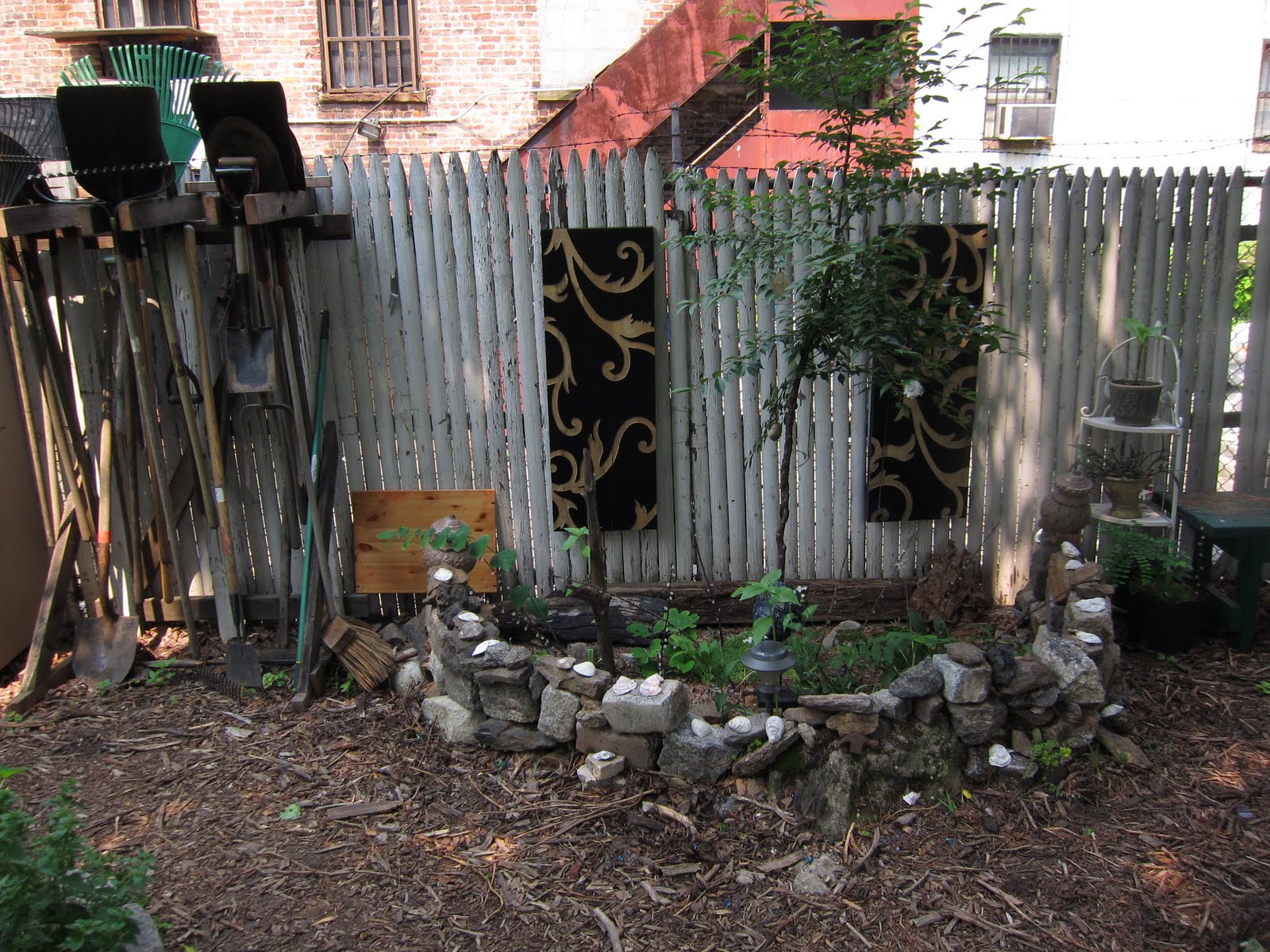
A neat assemblage including an outdoor tool rack
-----------------------

And from the All Peoples Garden in the Lower East Side of Manhattan, a beautiful new photorealistic mural of the garden's founder Olean For:


Wednesday, June 1, 2011

Early Years : Garden Plan to Reality

Having a plan for the garden is wonderful but without gardeners to make it happen... well it is just a sketch. The plan called for a bit of heavy labor to remove the old raised  beds and build new ones. At the time there were not very many outside groups offering to help with a labor force. The only one I can remember was C.A.S.E.S. and alternative to incarceration program for those convicted of misdemeanors. Today there are many corporate groups, citywide volunteer organizations like New York Cares and job and skill training groups like N.E.W. and the Green Apple Corps looking for volunteer opportunities. 

There was a guy I knew, Mike Gorman, who was a teacher at an alternative high school called Manhattan School for Career Development (MSCD) which was about 4 blocks from the school. The students needed field training leading to non-college career opportunities. The garden provided some opportunities and Mike was very interested in having his students spend time in the garden to learn construction skills, horticulture and garden maintenance, i.e. pulling weeds, pruning and cleanup. So this group spent a lot of hours in the garden to make the sketch become reality.

Fences were removed and most important the fence that created the alleyway alongside the garden was moved to cut off the drug highway/ alleyway and in the process add an extra 500 square feet to the east side of the garden. Other gardens took the fencing and poles and hardware to use at their gardens. The raised planter in the front of the garden was initially repaired and eventually removed as it was never used for it's intended purpose for senior or disabled gardeners.
New Structure shortly after it was built.
Note the series of chain link fences. Drug Alley in rear of photo


The neighborhood was still awash in drugs and there was a sizable homeless population although the Dinkinsville and other encampments were gone. The 6BC garden (which was called Sixth Street Community Center Garden at the time) had our own homeless person named Junior who moved into the ramshackle shed that held our garden tools. The MSCD crew rebuilt the shed around Junior and we tried to keep his possessions separate from the garden stuff. He would help sweep and carry supplies as they arrived especially if someone gave him a couple of dollars to buy something alcoholic to drink. A number of folks in and outside of the garden tried to work with Junior to find him shelter and services but he preferred to be in the garden and lived there until he died a few years later. 

There were many things happening in the community gardening world at this time that would impact the 6BC Garden. A group of organizations that provided assistance to the community gardens were meeting as an ad hoc group called the Lower East Side Technical Assistance Group, spearheaded by the Green Guerillas. We worked with architect Michael Kwartler who had just developed the Environmental Simulation Center. This was the beginnings of the use of computer modeling for Urban Planning and to use computers to do sun/shade modeling.  He was able to develop plans and drawings that showed how the Lower East Side could have housing built on truly vacant land and the community gardens could continue to exist and thrive.

 Kwartler Map. Gardens are shown as flowers. 6BC labelled.  

There were constant contentious meetings of the local community board that were often disrupted by demonstrators opposed to the types of development that were proposed. Gardens were given 5, then 10 year leases as a step toward permanency. A few gardens were transfered to the Parks Dept from the Departments of General Services and Housing Preservation and Development. Some members of the 6BC garden began to put together documents and photos depicting the positive impact that the garden had on the community in preparation for the coming battles to preserve not only this garden but all of the community gardens in NYC. That's the next chapter.

Sunday, May 8, 2011

Community Gardening - My Early Years- Part 2

The next part of the story begins the physical changes to the garden. The 6BC group was not well organized, meetings did not happen and no one bothered to renew the lease with Operation GreenThumb. I was determined to do something. I had recently started working at council on the Environment and I was learning about the world of community gardening in New York City. t that time there was no long term protection for community gardens. Some discussions were taking place and there some gardens were being offered long term - 5 year - leases.  The housing market was opening up and the Lower East Side was prime territory for development. The local community board was working on a cross subsidy plan as a way of insuring that there would be some low income development alongside the market rate housing. The plan was that for every market rate apartment built, developers were to subsidize a low income apartment. The plan saw few if any low income apartments built as result of the cross subsidies. The 6BC lot together with the lot on 5th Street made it a large assemblage and attractive for developers.


Something had to be done to preserve this garden space so I took it upon myself to sign the lease for the garden. The added benefit was that the garden would be eligible for materials like lumber, concrete and tools that could be used to rebuild the raised beds. I drew up plans for an arbor in 1989 and began showing them around to the gardeners. I got positive feedback to the plans and a few folks expressed an interest in helping to build the structure and rebuild the raised beds. At the time, I was driving the Grow Truck for Council on the Environment and I was able to arrange to pick up and deliver the materials for the structure.

A small group worked with me over the course of several weekends to dig holes, pour concrete, set the posts and build the structure with a built in bench.With all of the building going on the garden looked more like a a construction zone. The structure looked great when it was completed, it looked like the first house to be built in a new development before all of the other houses were built, the trees planted and the families moved in. The structure was installed at approximately a 45 degree angle to the street.


After the success of the arbor project, I worked on an overall plan for the garden that I completed in 1990. The plans called for placement of raised beds in the garden following the same diagonal as the arbor. This shift in the layout served several purposes. It provided visual interest - something different from the rectangular monotony of the streetscape. Manhattan's street grid was laid out following the general shape of the island which sits on a Southwest / Northeast plane. The diagonals in the garden were closer to a true North - South line.  The placement of the structure at this diagonal near the front created a passage into the rest of the garden and gave the visitor or gardener a heightened sense that they had left the street and the rest of the city behind. The diagonal layout left triangular areas in the 4 corners that could and would be used as  seating areas and a large entry area. Part of my thinking at the time was that when different groups of gardeners or visitors were in the garden at the same time, if one area was being used, a second group could use an area in the opposite corner.


There were a few trees and shrubs in the garden that remained and we built around them. There was still the problem of the extra fences dividing the garden and creating the drug alleyway. There was a small, not very well built shed that needed work. All of these existing elements of the garden needed to be addressed and a new group that would spend a good deal of time in the garden over the next few years helped with that process..... that story in the next post.

Sunday, May 1, 2011

Community Gardening - My Early Years

                                               The 6BC Community Garden mid 1980's

This inspiration for this post came to me the other day when a writer doing research for a book she is writing asked me about urban agriculture in the 1970's and 80's. Well, we didn't call what we were doing at the time urban agriculture. It was community gardening.  I can't say much from personal experience about community gardening in the 1970's. It was happening at the time and the seeds of the modern community gardening/ urban agriculture movement were planted at that time.

I can talk from experience about community gardening in the 1980's. I started community gardening at the 6BC community garden in the early 1980's. At the time the garden was a dysfunctional mix of neighbors on the block including Puerto Rican and African American families, twenty something whites who recently moved into the neighborhood and a teacher and her elementary school students from the public school on the block. The garden was divided by chain link fences. One older man gardened by himself in a fenced off section where he grew a lot of tomatoes, peppers and cucumbers. A Puerto Rican extended family gardened in several raised beds, including one that was mostly taken up with a large rose bush. Someone tended a pot of annuals in from of a shrine to the Virgin Mary where often a votive candle was kept burning. I started gardening on half of a raised bed by growing a couple of tomato plants and a few herbs.

A handicap accessible raised bed was little used; there were no disabled gardeners. Most of the raised beds were made of rotting or patched together lumber. Some of the pathways were lined with brick others were just hardpan. The compost area was an unkempt pile of weeds, twigs and branches. The garden had a few trees and shrubs that were haphazardly planted. The group was not well organized and the gardeners were distrustful and antagonistic toward each other. Vandalism and theft were rampant. Just as a tomato ripened it disappeared.

The neighborhood was in the midst of a heroin epidemic. The way that the garden was fenced, a narrow alleyway ran the length of the building adjacent to the south side of the garden that continued through to the adjacent street. This alleyway was a convenient drug distribution point as the dealers could escape in either direction if the police arrived. If you were in the garden at the right times, usually late morning and at dinner time, you would notice a number of disheveled looking men and women nervously pacing near the garden looking suspiciously up and down the block. All of a sudden the dealer would arrive, everyone would form a neat line and in no more than 5 minutes the drug exchange would be finished. During off hours for the drug trade the alleyway was used for urinating and prostitution.

This lawlessness found it's was into community gardens throughout the city. Theft and vandalism were major problems for many gardens. Sheds could not be made vandal proof, so tools could not be safely stored. Annuals, perennials and shrubs with showy flowers could not be planted. Mother's Day was dreaded; it was the day of the year with the highest incidence of robbery. More than a few moms received presents of flowers or plants that were nurtured in a community garden. In fact the Green Guerillas distributed a fact sheet on how to prevent vandalism that showed gardeners a method for chaining and locking shrubs to deter theft!

Not a very auspicious beginning for a movement or a career but small or humble or difficult beginnings very often yield amazing results with perseverance and luck. More chapters to come.

                                                    6BC Community Garden circa 2002

Friday, April 8, 2011

Spring Mix

I participated in a third spring event, the GreenThumb GrowTogether which took place on Saturday April 2nd. Attended by 1200 people with 55 workshops (2 I led), this was a great event that continues to be 'the official first day of spring' for New York City community gardeners, according to Parks Commissioner Adrian Benepe. This year's keynote speaker, Joan Dye Gussow, following up on the soil thread of my recent posts, spoke about how just a pinch of soil has more than a billion organisms, some that have yet to be identified.

The two workshops I led were Rainwater Harvesting presented along with my co-worker Lars Chellberg attended by 30 people interested in installing rainwater systems in their gardens. And a workshop on making what I call Grow Sacs. These are polyester bags which are upcycled into planters which can be hung on fences or walls. Simple directions here: Both workshops were videotaped. When time permits I will edit them to share.


See previous posts about vertical gardening:
Vertical Gardening
Vertical Gardening Update
Vertical Gardening Update II

It wouldn't be Spring without some threat to community gardening in NYC. This year it is the wrangling in Washington over the federal budget. One of the items on the chopping block by the Republican Tea Party is the Community Development Block Grants (CDBG) which is a way that the Feds provide money to cities and states for many social services and development programs and projects. New York City's GreenThumb Program receives 100% of it's funds through CDBG. The verdict isn't in yet but it would be a crime if the Republicans prevail and GreenThumb and other worthy programs lose their funding. If NYC politicians allow GreenThumb to lose it's funding it would be even a bigger crime.

A Couple of Spring Garden Scenes

The Perennial Veggies and Herbs in My Garden
Left to Right Front: Rhubarb, Chard,
Middle: Horseradish, Sorrel
Rear: Comfrey, Parsley (a biennial)

Great to see the greens coming up in the otherwise bare garden


Bloodroot - a wonderful spring ephemeral!